Teaser: Gold rebounded from earlier losses on Friday as weakness across technology stocks, driven by concerns over stretched artificial intelligence valuations, boosted safe-haven demand. Sharp swings in equity markets earlier in the week had prompted some investors to liquidate bullion positions to offset losses elsewhere in their portfolios, contributing to gold’s decline to its lowest level since November. Sentiment improved after the latest US inflation data came in softer than expected, tempering expectations of an imminent Federal Reserve rate hike. Bond markets subsequently trimmed the probability of additional tightening this year, with the likelihood of a rate increase at the next policy meeting falling to around one-in-three. Despite the modest recovery, the broader outlook for bullion remains constrained as policymakers continue to signal a restrictive monetary policy stance. Elevated Treasury yields and a resilient US dollar continue to reduce the appeal of non-yielding assets, while investors now await upcoming economic data and Fed commentary for further direction on the interest rate outlook.
Introduction:
Gold and silver remained under pressure through the week as the Federal Reserve's hawkish policy stance and a resilient US dollar continued to outweigh support from easing geopolitical tensions. Markets increasingly priced in a higher probability of further policy tightening after policymakers reinforced their commitment to containing inflation, reducing demand for non-yielding assets. Although progress in US-Iran negotiations and hopes of a lasting ceasefire helped ease concerns over the Strait of Hormuz, the resulting decline in crude prices also reduced safe-haven demand for bullion. In the week ahead, precious metals are expected to remain driven by US macroeconomic data, Fed policy expectations, and developments surrounding the Middle East peace process, with any signs of softer inflation or weaker economic momentum offering scope for a technical recovery. WTI crude futures remained on the defensive as improving prospects for a comprehensive USIran agreement continued to erode the geopolitical risk premium that had supported prices during the conflict. Reports of a structured roadmap toward a final peace deal, uninterrupted crude flows through the Strait of Hormuz, and preparations by Gulf producers to raise output reinforced expectations of improving supply conditions. Although intermittent military rhetoric generated brief volatility, traders largely focused on the prospect of increased production and easing regional tensions. Crude is expected to remain highly headline-driven, with prices likely to stay under pressure if diplomatic progress continues, while any disruption to negotiations or renewed threats to Hormuz transit could quickly restore supply-risk premiums and trigger a sharp rebound.
Gold:
Gold fell to around $4,050 an ounce on Monday, snapping a two-day rebound as renewed exchanges of attacks between the US and Iran over the Strait of Hormuz lifted oil prices and rekindled inflation concerns. The conflict escalated since Thursday, with Iran targeting a container ship, a vessel carrying Qatari oil, and military bases in Kuwait and Bahrain, prompting multiple US retaliatory strikes. However, both sides later agreed to suspend further attacks ahead of peace talks set to resume this week in Doha, Qatar. Meanwhile, Friday's data showed US PCE inflation broadly matched expectations, leading investors to slightly pare back bets on Federal Reserve rate hikes this year. Markets are now awaiting the latest US monthly jobs report and the ISM Manufacturing PMI for further clues on the outlook
for monetary policy.
Technical View: Gold remains structurally weak after breaking below its 4098(MCX:144750) weekly fractal low, threatening an extended decline toward major support at 3885(MCX:137200). However, a bullish divergence in the RSI creates an opportunity for a corrective recovery toward immediate resistance caps at 4130(MCX:145850) and 4240(MCX:149700). An unexpected rise past the 4385(MCX:154800)-risk point neutralizes the bears and improves the scope toward 4420(MCX:156000).
Silver
Silver fell to around $58.5 an ounce on Monday, snapping a two-day rebound as renewed exchanges of attacks between the US and Iran over the Strait of Hormuz lifted oil prices and rekindled inflation concerns. The conflict escalated since Thursday, with Iran targeting a container ship, a vessel carrying Qatari oil, and military bases in Kuwait and Bahrain, prompting multiple US retaliatory strikes. However, both sides later agreed to suspend further attacks ahead of peace talks set to resume this week in Doha, Qatar. Meanwhile, Friday's data showed US PCE inflation broadly matched expectations, leading investors to slightly pare back bets on Federal Reserve rate hikes this year. Markets are now awaiting the latest US monthly jobs report and the ISM Manufacturing PMI for further clues on the outlook for monetary policy.
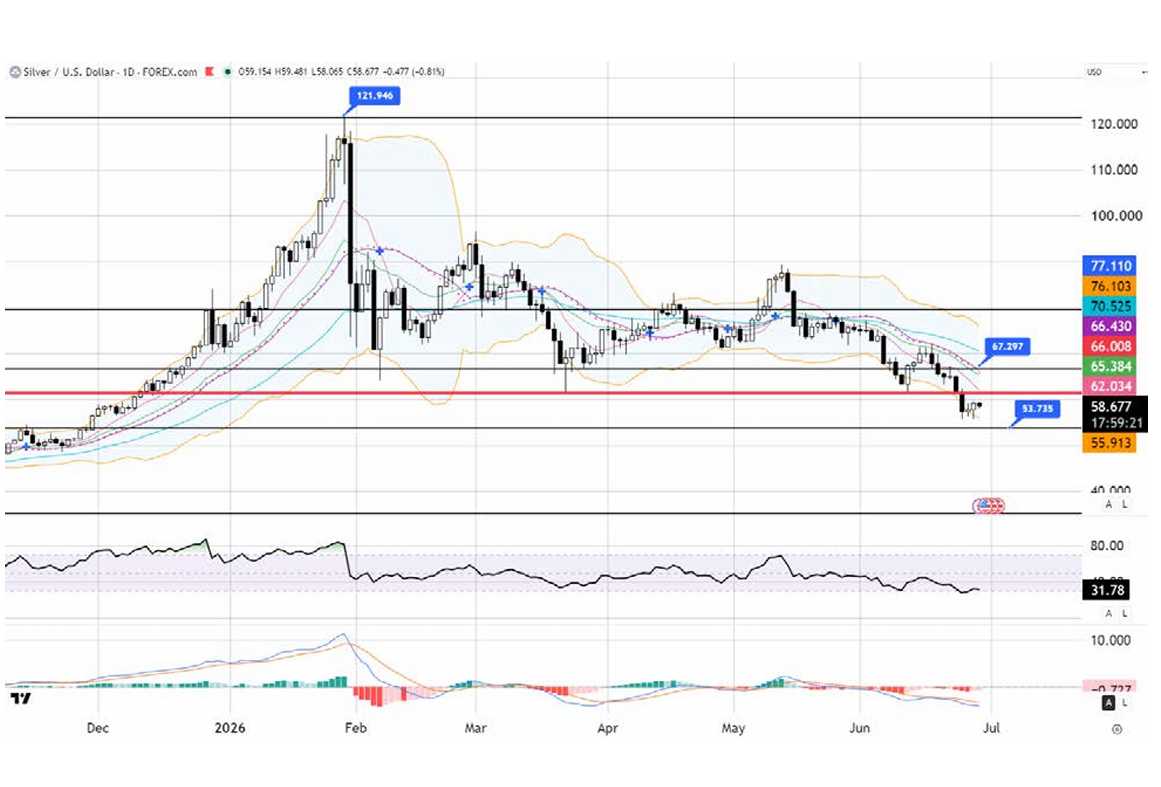
Technical View: The support zone at $57–56(MCX:215700/211900) remains crucial, with prices holding above it likely to trigger a recovery towards $6667(MCX:250000/254000). An unexpected fall below $55(MCX:208400) would invalidate the bullish view.
Crude Oil
Crude oil climbed to around $70 per barrel on Monday, recovering modestly from four-month lows after a series of tit-for-tat attacks between the US and Iran over the Strait of Hormuz. The two sides, however, agreed to halt further strikes ahead of peace talks set to resume later this week. The exchange of attacks began on Thursday when Iran targeted a container ship, prompting US strikes the following day. Washington launched another round of attacks on Saturday after Tehran struck a vessel carrying Qatari oil. Meanwhile, Axios reported that US and Iranian officials are scheduled to meet in Doha on Tuesday to discuss the Strait of Hormuz and other issues aimed at ending the conflict. Despite the renewed tensions, shipping activity through the vital waterway has picked up since the US and Iran reached an interim peace agreement, although shipowners remain cautious as hundreds of vessels are still stranded in the Persian Gulf.
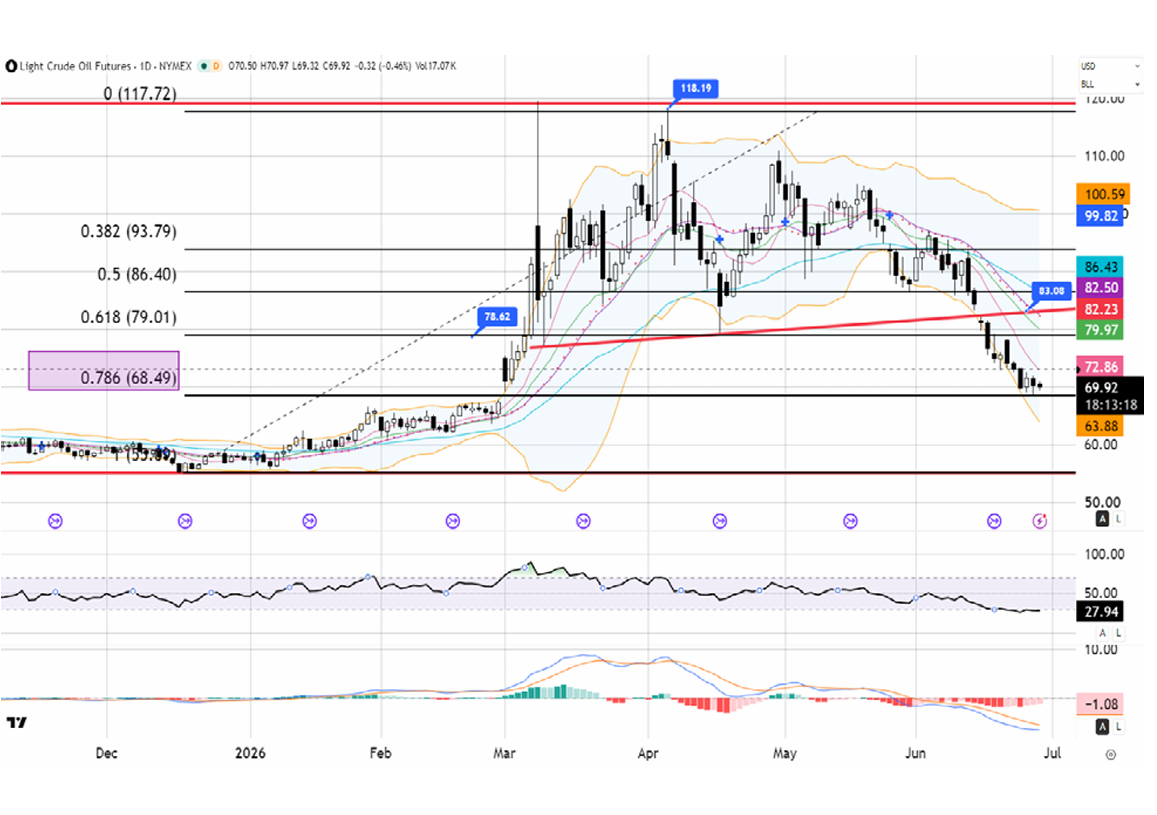
Technical View: Price remains under pressure, favoring a near-term extension toward $67.35(MCX:6380) and 62.35(MCX:5905). Corrective bounces face resistance caps near 71.90(MCX:6810) and 73.80(MCX:6990). An unexpected recovery past the 78.35(MCX:7420) risk point neutralizes the bearish outlook, opening the path to 79.50(MCX:7530) and 82.75(MCX:7840).
Copper
Copper prices decline in early Asian trading, with the three-month LME copper contract down 0.5% at $13,212.50 a ton. A stronger dollar following the Fed's hawkish stance at this month's meeting has weighed on prices, but easing inflation concerns as oil retreats toward pre-conflict levels have improved the broader macro backdrop, Guotai Junan Futures analysts write in a note. Downside may be limited as easing macro risks and bargain hunting by downstream buyers are supporting copper's fundamentals. Tight copper concentrate supply is increasingly constraining refined copper production in China, Guotai Junan adds.
Technical View: Price structure is favoring a near-term dip toward 6.07(MCX:1256). The technical structure suggests the price will stay capped under 6.30/6.35(MCX:1285/1293) to test the critical support at 5.90(MCX:1236). An unexpected breakout above the 6.35(MCX:1293) encourages buying toward 6.45(MCX:1306)