Teaser: Gold remained on track for a second consecutive weekly decline as expectations of higher interest rates continued to weigh on the non-yielding asset ahead of next week's Federal Reserve policy meeting. Precious metals have remained under pressure since the onset of the Middle East conflict, as elevated energy prices have fueled inflation concerns and strengthened the case for a prolonged period of restrictive monetary policy. While gold is traditionally viewed as a hedge against inflation, rising interest rates increase the opportunity cost of holding bullion and tend to limit investor demand. Markets are currently pricing in a meaningful probability of a Fed rate hike by year-end, while attention is increasingly shifting toward the upcoming policy meeting under new Fed Chair Kevin Warsh. Investors will closely monitor the central bank’s outlook on inflation, growth, and future rate guidance, with any hawkish signals likely to influence precious metals sentiment in the near term.
Introduction:
Gold and silver started the week under pressure as renewed US-Iran hostilities lifted crude prices and revived inflation concerns, strengthening expectations that the Fed may keep policy tight for longer. Bullion fell sharply mid-week as higher oil prices raised the risk of future rate hikes, increasing the opportunity cost of holding non yielding assets. However, sentiment reversed toward the end of the week after Trump called off planned strikes on Iran and reports suggested that Washington and Tehran were moving closer to an agreement to end the war and reopen the Strait of Hormuz. This pulled crude lower, eased inflation fears, weakened the dollar and supported a recovery in precious metals. Going ahead, gold and silver may remain supported if peace momentum continues, though Fed policy risks could still cap upside.
WTI crude remained volatile but turned sharply lower by the end of the week as hopes for a US-Iran peace deal eroded the geopolitical risk premium. Prices were initially supported by renewed conflict risks, tight inventories and fears of prolonged disruption through the Strait of Hormuz. However, sentiment weakened after Trump cancelled planned strikes and reports indicated that both sides were close to a memorandum aimed at halting the war and restoring Hormuz flows. WTI settled sharply lower, with traders increasingly pricing in improved supply availability rather than escalation risk. Going ahead, crude could stay under pressure if diplomatic progress continues, while any setback in talks may quickly revive supply-risk premiums.
Gold:
Gold climbed toward $4,300 an ounce on Monday, advancing for a third consecutive session after the US and Iran reached a peace agreement that would reopen the Strait of Hormuz. Oil prices declined to a two-month low following the announcement, easing concerns over rising inflation and the prospect of interest rate hikes that have weighed on bullion. The agreement is set to be signed in Switzerland on June 19 and reportedly includes the lifting of blockades, sanctions relief for Iran, and the dismantling of Tehran’s nuclear program. Meanwhile, the US Federal Reserve will hold its first policy meeting this week under new chair Kevin Warsh and is widely expected to keep interest rates unchanged. The Reserve Bank of Australia is also expected to leave policy steady, while the Bank of Japan is likely to raise rates in support of its currency.
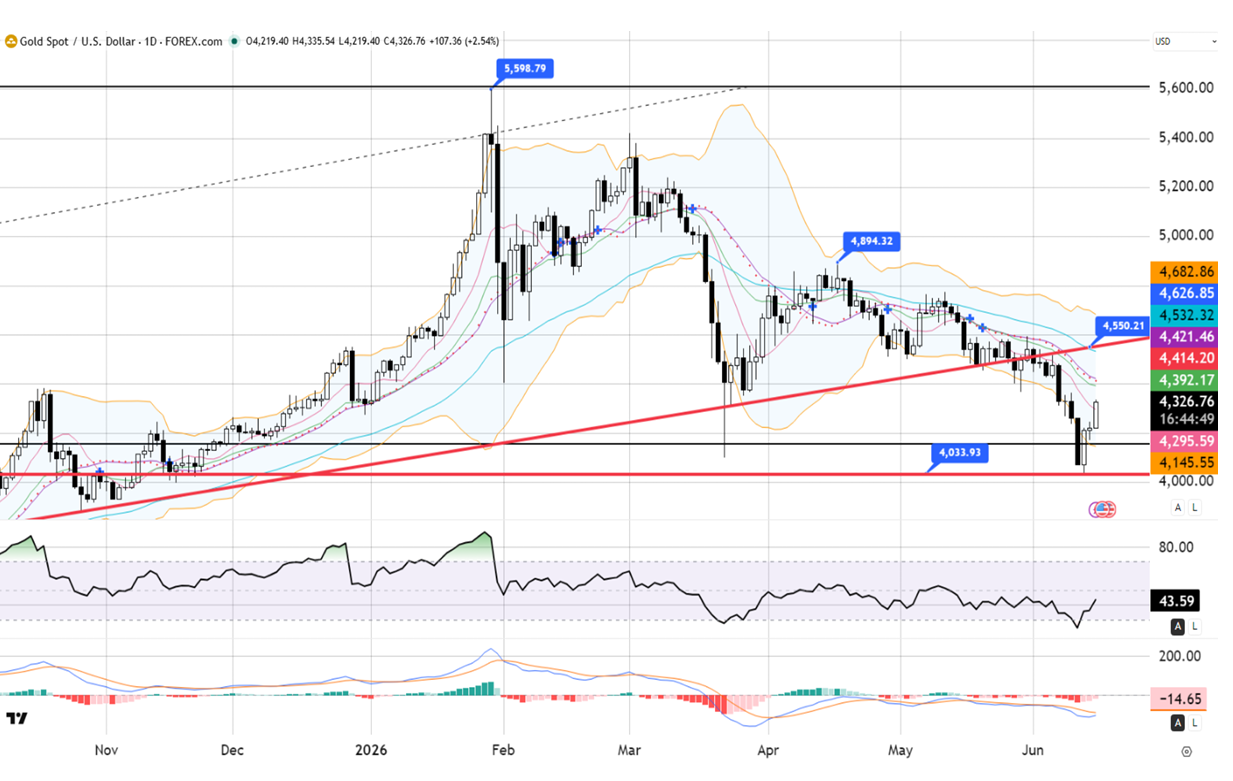
Technical View: $4326.03. The breakdown past a crucial fractal low and the 50-week EMA flags structural weakness, targeting major weekly support at 3887. However, Friday's pivotal daily upturn on the lower Bollinger Band suggests a minor corrective bounce toward 4305/4310 before the downtrend resumes. Crossing 4365 strengthens recovery momentum, targeting the trend's final defence line at 4435.
Silver
Silver jumped above $70 an ounce on Monday, advancing for a third consecutive session after the US and Iran reached a peace agreement that would reopen the Strait of Hormuz. Oil prices declined to a two-month low following the announcement, easing concerns over rising inflation and the prospect of interest rate hikes that have weighed on precious metals. The agreement is set to be signed in Switzerland on June 19 and reportedly includes the lifting of blockades, sanctions relief for Iran, and the dismantling of Tehran’s nuclear program. Meanwhile, the US Federal Reserve will hold its first policy meeting this week under new chair Kevin Warsh and is widely expected to keep interest rates unchanged. The Reserve Bank of Australia is also expected to leave policy steady, while the Bank of Japan is likely to raise rates in support of its currency.
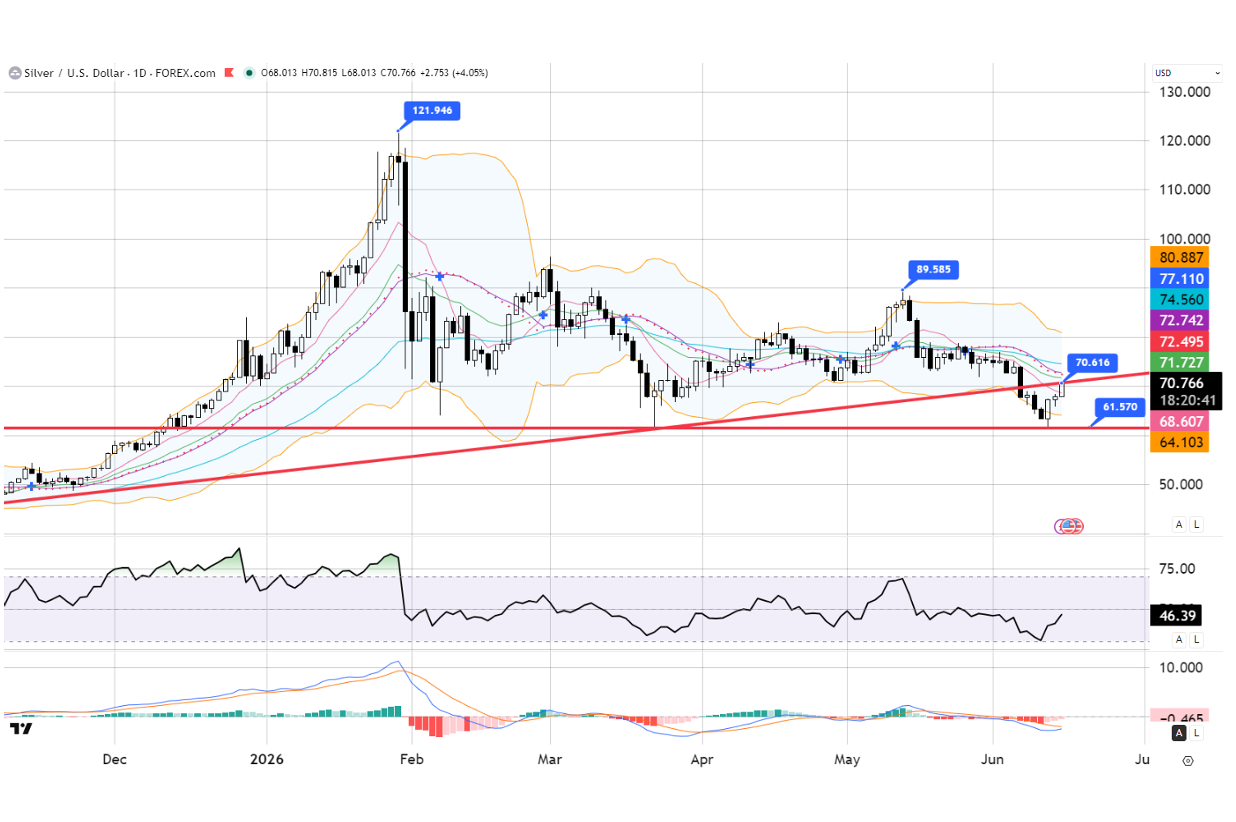
Technical View: $70.76. Support at $63–65 remains pivotal, with stability above this zone likely to pave the way for a move towards $72–73. A n unexpected break below $62 would weaken the outlook and stall the expected bullishness.
Crude Oil
Crude oil plunged more than 4% to around $81 per barrel on Monday, touching a two-month low after the US and Iran reached a peace agreement aimed at ending the Middle East conflict and reopening the Strait of Hormuz by the end of the week. President Donald Trump announced that oil shipments from the Persian Gulf could soon resume, including the lifting of a US blockade on Iranian ports. The agreement also reportedly includes provisions for dismantling Iran’s nuclear program, along with economic incentives if Tehran meets its commitments. Iranian Deputy Foreign Minister Kazem Gharibabadi confirmed that a deal had been reached and said the text would be released following a signing ceremony in Switzerland. Oil markets have faced significant disruption since the conflict erupted in late February, with the near closure of the Strait of Hormuz affecting roughly one-fifth of global oil shipments.
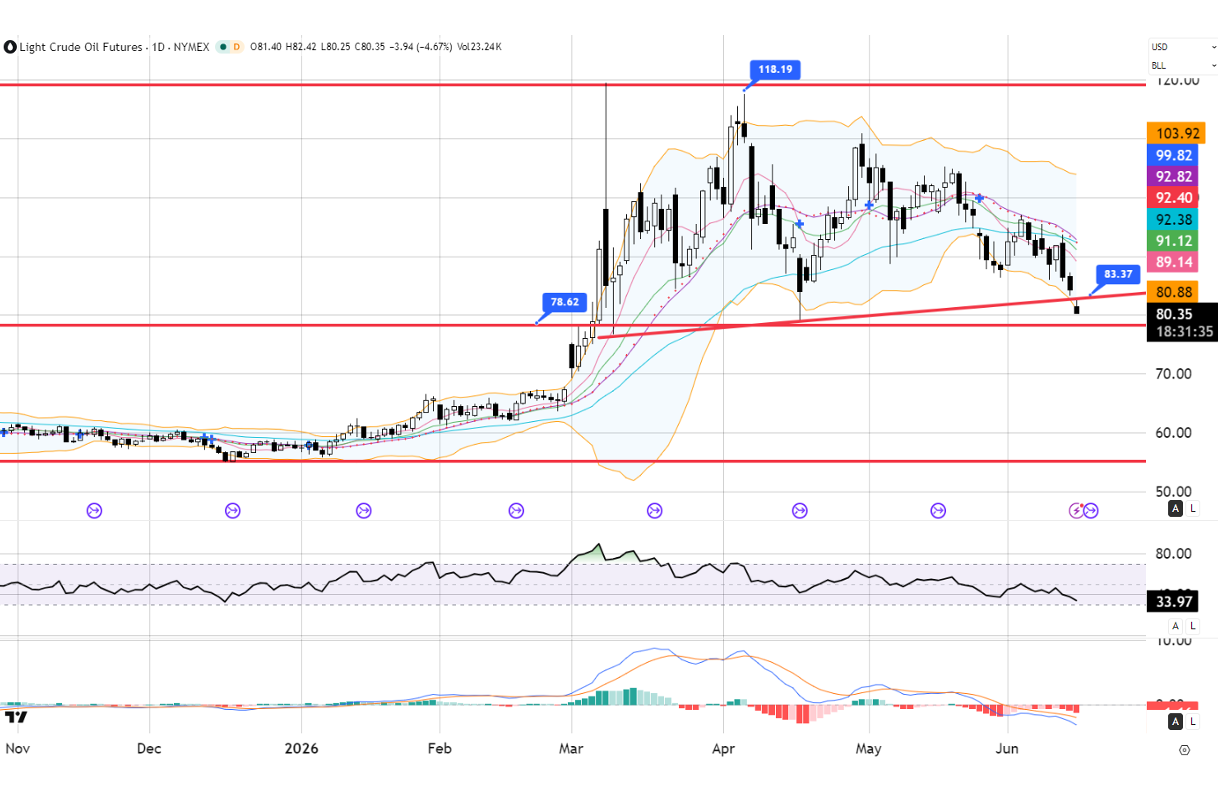
Technical View: $80.35. The structure favors continued downside, with a daily swing objective at 78.15 matching the critical weekly supertrend support at 78.20, followed by the 50-week EMA at 74.25. Upside resistance caps recovery at 88.90, 90.10, and 91.50, requiring a break above 95.60 to challenge major peaks at 97.00/104.00.
Copper
Copper prices strengthened on Friday, recovering from recent three-week lows as easing concerns over the Middle East conflict improved sentiment toward global growth and industrial metals demand. Optimism surrounding a potential U.S.-Iran peace agreement helped support risk appetite, while ongoing supply-side constraints continued to provide a strong fundamental backdrop. Copper concentrate treatment charges remained under pressure, reflecting tight raw material availability, and several smelters have reportedly reduced production due to concentrate shortages. Physical supply has also tightened in certain regions, pushing spot premiums back into positive territory and highlighting improving near-term demand conditions. However, stronger-than-expected U.S. inflation data reinforced expectations that the Federal Reserve may maintain a restrictive monetary policy stance, potentially limiting future demand growth. Despite these macro headwinds, the longer-term outlook remains constructive, with analysts projecting persistent global supply deficits through the end of the decade, supported by slower mine supply growth and continued demand from electrification, infrastructure, and energy transition sectors.
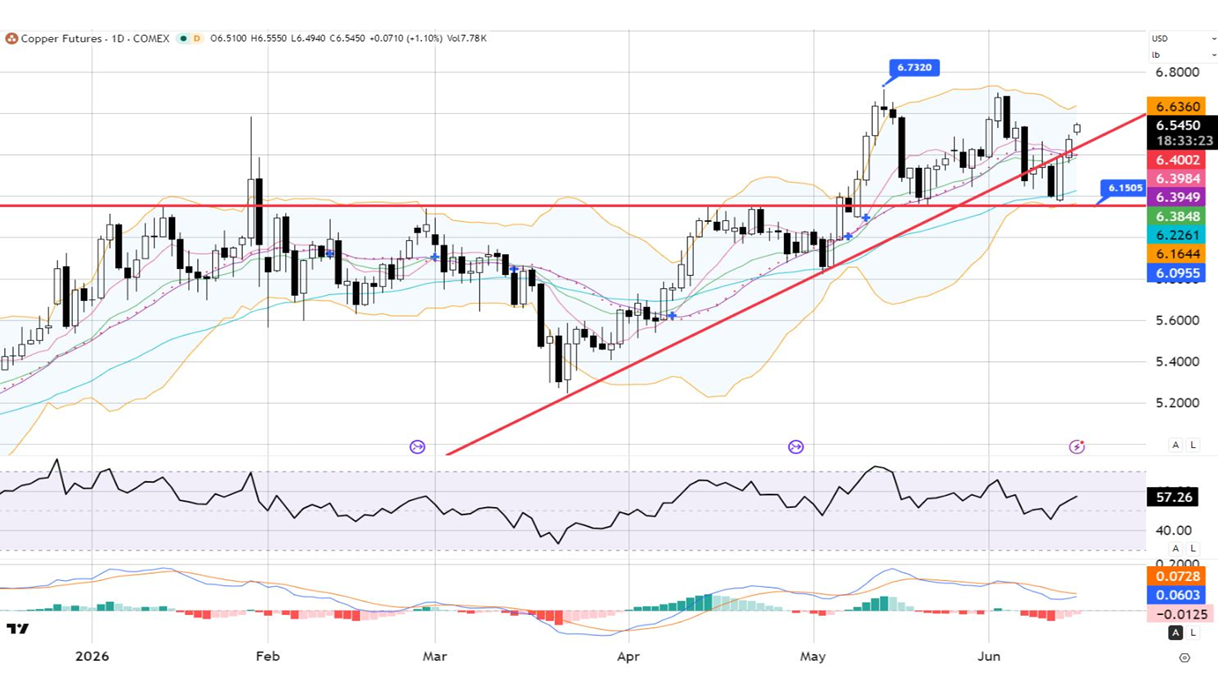
Technical View: $6.54. Supports to be observed at $6.25/6.30 where dips can hold for a rise to $6.75/6.80 near term. Only an unexpected breakdown below $6.16 could dampen our bullish expectations.