Teaser: Gold prices fell over 4% to $4,600 per ounce on Thursday, halting a four day winning streak, as the US currency and oil prices soared following President Donald Trump's promise to continue strikes on Iran. His comments, which confirmed that the US had "nearly accomplished" its military goals but gave no indication that the month-long fight would finish, raised concerns about inflation and strengthened expectations of rising interest rates. Gold denominated in dollars has now lost 13% of its value since the conflict started on February 28 due to the dollar's safe-haven rise. On Thursday, U.S. President Donald Trump crushed hopes of a quick end to the Middle East conflict, sending oil prices skyrocketing and global equity and bond markets recoiling once more. Trump stated that the United States would step up its attacks on Iran within the following two to three weeks in a highly anticipated speech on Wednesday. He had just assured Reuters that the United States will be "out of Iran pretty quickly" the day before.
Introduction:
Gold remained under sustained pressure through the period, extending its corrective phase as elevated energy prices and persistent geopolitical tensions reinforced inflation risks and delayed expectations of monetary easing. Early on, as markets progressively priced out near-term rate reduction, a stronger currency and rising Treasury rates caused prices to hover close to the bottom band of the recent range. Gold briefly stabilised above important support zones as sporadic attempts at recovery surfaced in the hopes of diplomatic engagement and lowering conflict risks.
These gains, however, were short-lived since the metal's capacity to draw steady safe-haven inflows was hampered by ongoing petroleum volatility and persistent supply-side disruptions that raised inflation expectations. With declining central bank demand and continuous asset liquidation further limiting upside, bullion failed to regain higher levels as the period went on, confining prices to a weak consolidation with a bearish tendency.
Silver mirrored the broader weakness with sharper volatility, reflecting its dual natured exposure to macro and industrial drivers. Prices remained under pressure near recent lows as rising energy costs and tighter financial conditions weighed on industrial demand and reduced the appeal of non-yielding assets. A brief rebound on improving sentiment and short covering lacked follow-through amid a stronger dollar and elevated yields. Prices moved lower again, underscoring the fragility of the recovery. By the close, silver remained well below earlier highs, with near-term direction driven by macro tightening expectations, geopolitical uncertainty, and broader risk flows rather than a shift in underlying fundamentals.
Gold:
Gold slid toward $4,600 per ounce on Monday, extending losses from the prior session after President Donald Trump issued a fresh ultimatum to Iran and warned of strikes on its power plants and other civilian infrastructure if the Strait of Hormuz is not reopened. Trump said he would bring “Hell” to Iran and set a new deadline for Tuesday at 8 p.m. Eastern Time, while also indicating plans to hold a news conference at 1 p.m. on Monday. Tehran has rejected the latest ultimatum and continues to carry out attacks on energy assets across the Middle East. Gold remains down roughly 12% since the conflict began, as surging energy prices fueled inflation concerns and strengthened expectations of interest rate hikes. The metal has also struggled to perform its traditional safe-haven role, pressured by forced liquidations as investors moved to cover losses in other markets.
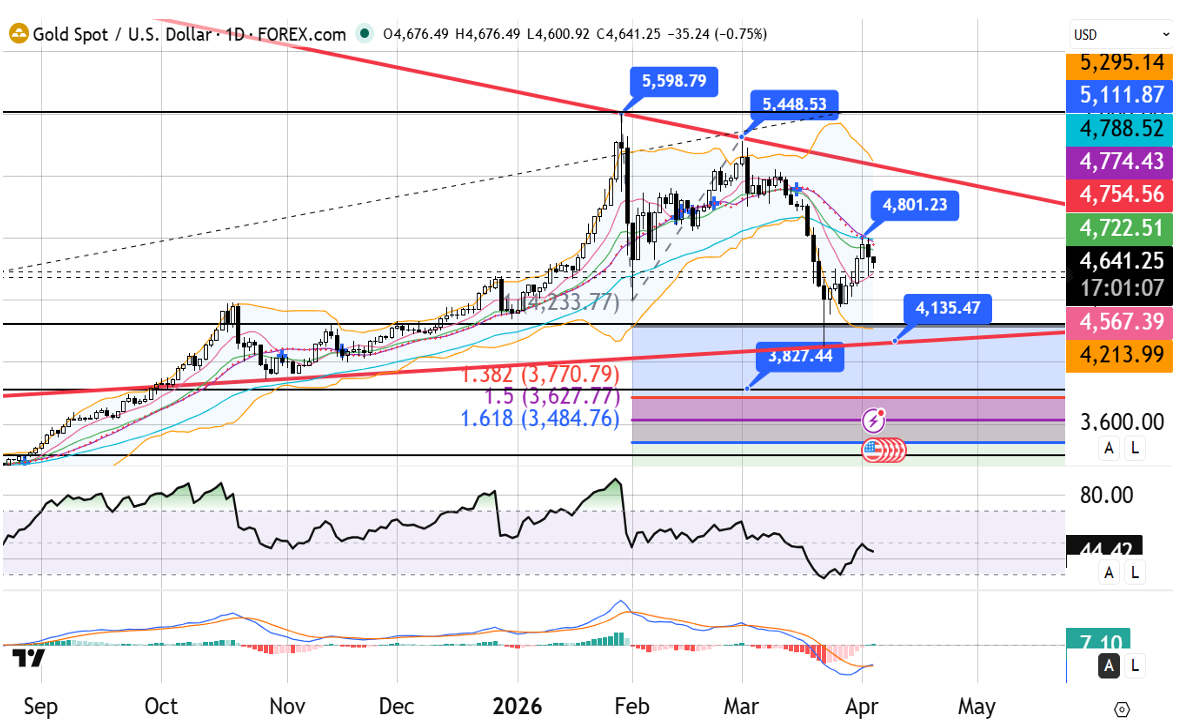
Technical View: $4641.25. Weekly chart shows a pivotal upturn near the 50-week EMA, indicating potential to rise towards $4905 and then 5073, though broader trend and momentum remain weak. Daily chart is clearer, with a bearish engulfing pattern after testing key averages, suggesting a drift lower while below 4805. Supports are seen near 4400, whereas a push above $4810 will revive the upside towards 4905 or higher.
Silver
Silver fell below $72 per ounce on Monday, extending losses from the previous session after President Donald Trump issued a fresh ultimatum to Iran and warned of strikes on its power plants and other civilian infrastructure if the Strait of Hormuz is not reopened. Trump said he would bring “Hell” to Iran and set a new deadline for Tuesday at 8 p.m. Eastern Time, while also indicating plans to hold a news conference at 1 p.m. on Monday. Tehran has rejected the latest ultimatum and continues to carry out attacks on energy assets across the Middle East. Silver has declined more than 20% since the conflict began, as surging energy prices fueled inflation concerns and strengthened expectations of interest rate hikes. The metal has also struggled to perform its traditional safe-haven role, pressured by forced liquidations as investors moved to cover losses in other markets.
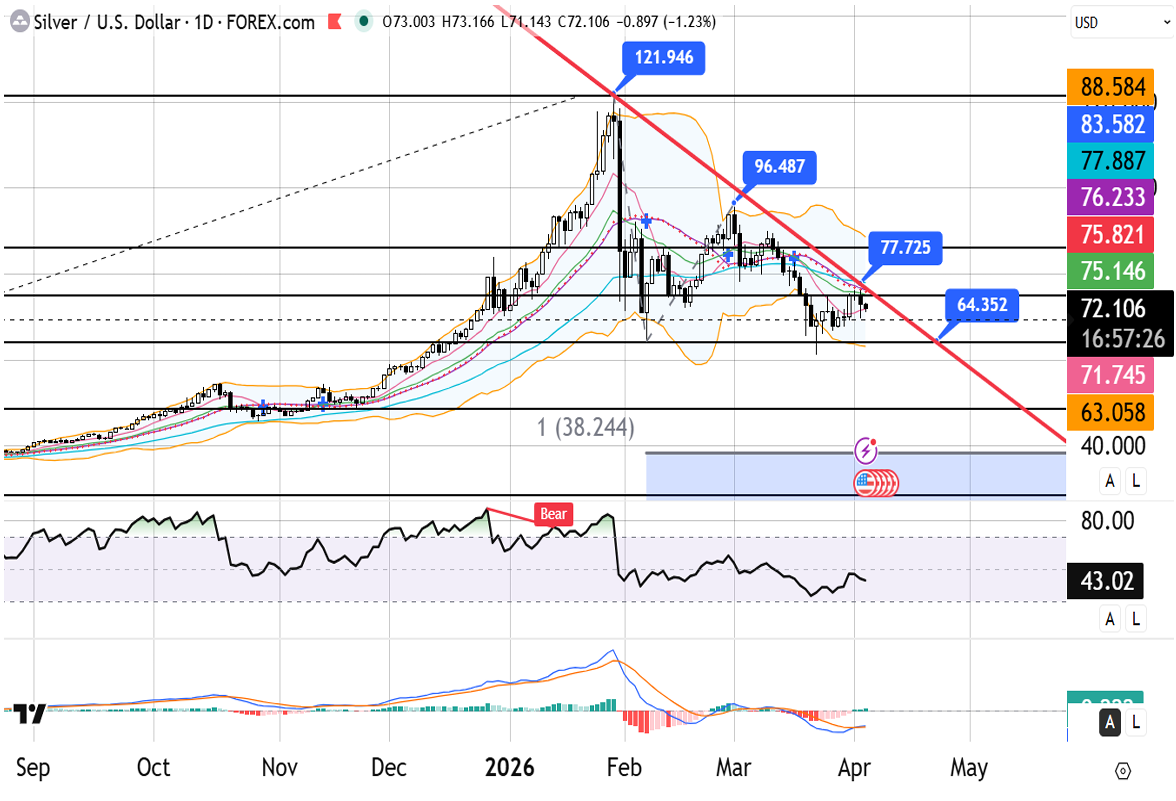
Technical View: $72.10. Resistance seen at $73-75 where upticks can cap for a dip to $60. An unexpected rise above critical resistance at $77 can negate our favored bearish view.
Crude Oil
WTI crude futures climbed to as high as $115.5 per barrel on Monday before giving up part of the advance, after President Donald Trump issued a fresh ultimatum to Iran and intensified threats targeting its civilian infrastructure if it failed to reopen the Strait of Hormuz. Trump warned he would bring “Hell” to Iran and set a new deadline for Tuesday at 8 p.m. Eastern Time, while also signalling plans to hold a news conference at 1 p.m. on Monday. Tehran rejected the latest demand, leaving Hormuz, an essential route for roughly a fifth of global oil and gas flows, effectively shut. Separately, OPEC+ cautioned after a weekend meeting that war-related damage to energy infrastructure could have lasting repercussions for oil supply even after the conflict subsides. The group approved a rise in output quotas to help address a global supply shortfall, although Iran indicated on Saturday that Iraq would be exempt from its restrictions in the strait.
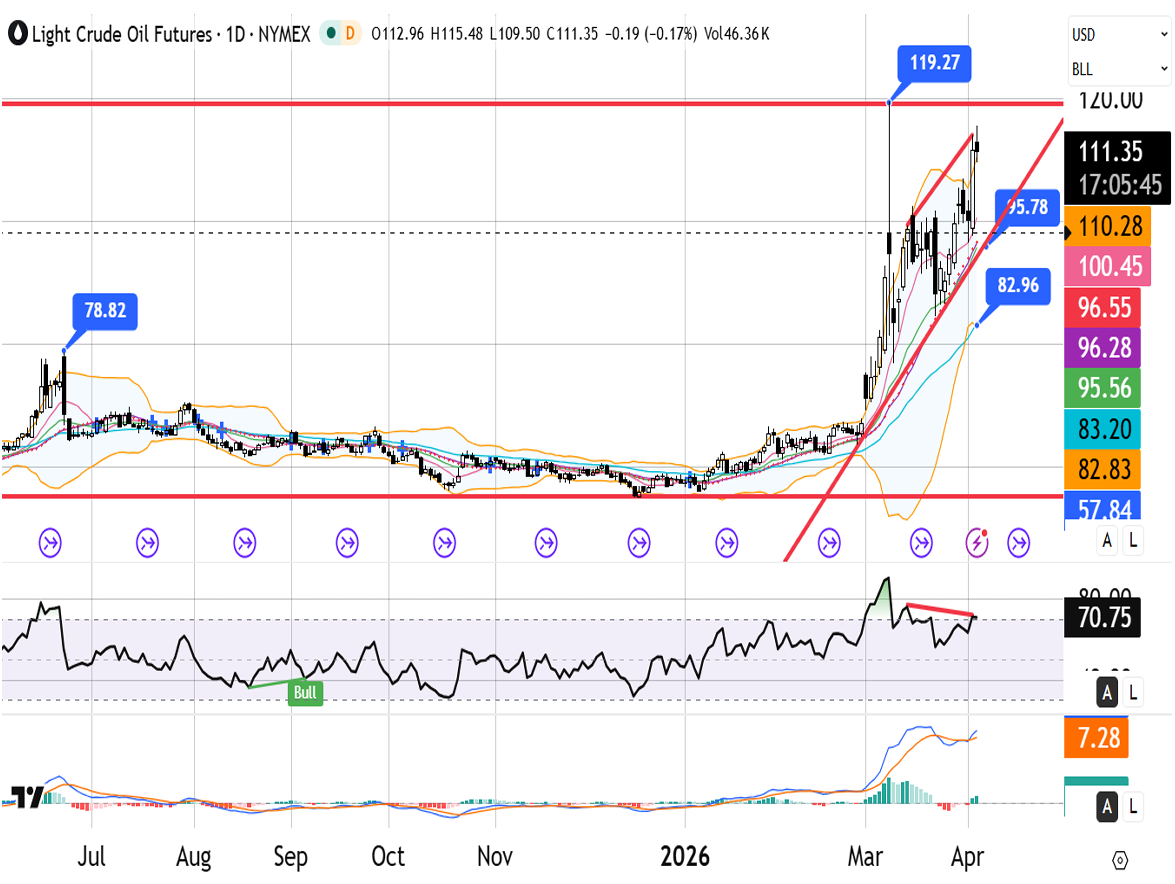
Technical View: $111.35 Weekly and daily structures remain aligned, pointing higher towards $118.90/119.60 and eventually 120.00. Supports are placed at 107.75 and 101.90, which are expected to cushion corrective dips. A break below 100.75 will weaken the bullish structure and expose the price towards 97.50 or even lower at 93.60.
Copper
Copper futures slipped to below $5.6 per pound, retreating from a two-week high amid renewed concerns over economic growth after US resident Donald Trump gave no clear timeline for ending the Iran conflict. Trump said Washington’s core objectives in the conflict were nearing completion, but gave no clear timeline for ending the war, while warning that the US could still strike Iran “extremely hard” over the next two to three weeks. He added that the US did not need the Strait of Hormuz, suggesting it would reopen naturally once tensions ease, though concerns over the waterway kept energy markets volatile. Copper, which has recently moved inversely to oil, came under pressure as higher energy costs and supply disruption risks clouded the demand outlook. The metal is also down about 10% year-to-date, weighed by abundant supply and rising inventories, with LME stockpiles near six-year highs and SHFE holdings close to record levels.
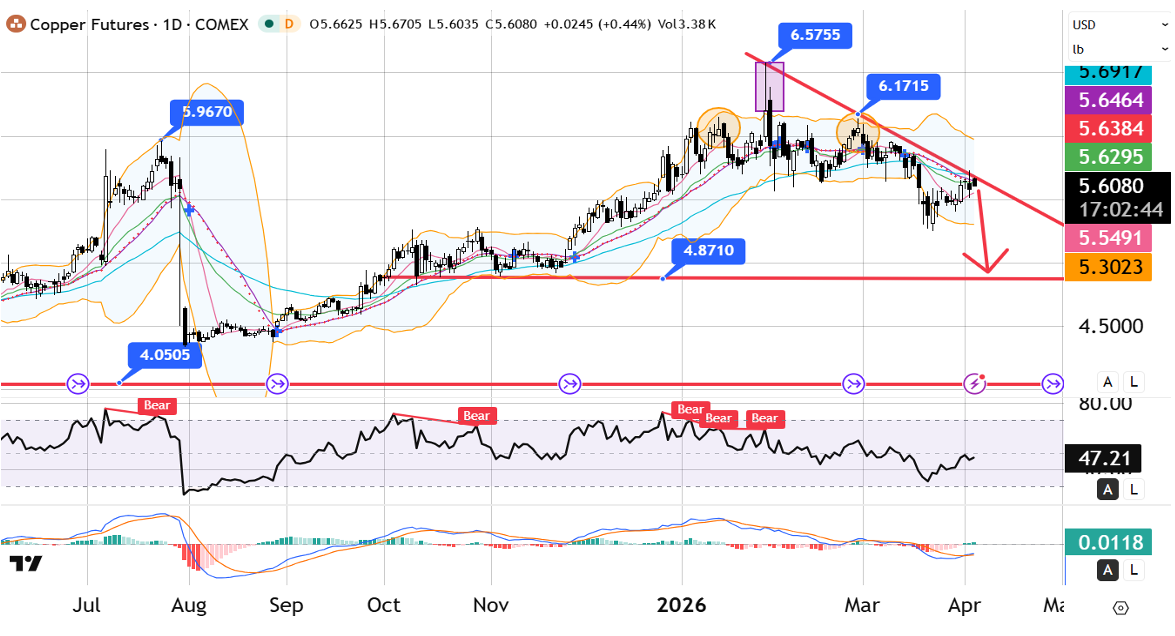
Technical View: $5.60. No change in the view. Upticks can get capped at resistance levels $5.75/5.70 with critical resistance at 5.95. Price is likely edge lower towards $4.85/80 if momentum sustains. Unexpected rise above $5.95 could turn the picture bullish again.