Teaser: Gold fell nearly 1% to around $4,450 on Monday, paring gains from the previous session as the Middle East conflict entered its fifth week with no clear resolution in sight. As Iran-backed Houthi fighters in Yemen entered the conflict and began attacking Israel over the weekend, hostilities in the area escalated. Additionally, the militant group is capable of attacking important Saudi Arabian oil facilities and ships passing via the Red Sea. Following the arrival of more troops in the area, the US military is apparently getting ready for weeks of ground operations in Iran. The oil price shock increased worries about inflation and strengthened predictions that major central banks would raise interest rates, which is why gold is still down more than 15% from its peak in March. As major nations provide liquidity to offset the economic impact of the Iran war, a reversal in central bank buying, which had previously bolstered gold's advance, further burdened prices.
Introduction:
Gold came under pressure near $4,450, extending its broader decline as the Middle East conflict entered a prolonged phase with widening participation and rising risks to energy infrastructure and shipping routes. While declining central bank purchases further undermined support, escalation kept inflation concerns high and reinforced views that major central banks could maintain a stricter policy stance. Before stabilising midweek as tentative ceasefire talks and diplomatic signals sparked a brief recovery above $4,500, prices fell toward $4,300 as resumed clashes and uncertainty surrounding negotiations kept sentiment fragile.
The recovery, however, was unsustainable, with prices returning to the $4,460 area as rising oil prices increased the value of the currency and bond yields. As a result, markets began to price out rate cuts and contemplate raising rates. Overall, inflation-driven policy expectations and high yields continued to influence price action, keeping gold under pressure despite sporadic demand for safe havens.
Silver tracked gold’s weakness with amplified volatility, trading around $68 as inflation concerns, rising energy prices, and geopolitical escalation weighed on both its safe-haven and industrial demand profile. A stronger dollar and higher rates caused prices to drop back below $69.5 after a brief rally near $74 on a reduction in risk sentiment and short covering failed to hold. Silver is still well below recent highs despite efforts to stabilise, and near-term price movement is still dominated by macro tightening expectations, geopolitical unpredictability, and cross-asset deleveraging.
Gold:
Gold fell nearly 1% to around $4,450 on Monday, paring gains from the previous session as the Middle East conflict entered its fifth week with no clear resolution in sight. Hostilities in the region intensified as Iran-backed Houthi militants in Yemen joined the conflict, targeting Israel over the weekend. The militant group also has the capacity to launch strikes on vessels transiting the Red Sea and key Saudi Arabian energy infrastructure. Meanwhile, the US military is reportedly preparing for weeks of ground operations in Iran after additional troops arrived in the region. Gold remains down more than 15% from its March peak as the oil price shock stoked inflation concerns and reinforced expectations for interest rate hikes from major central banks. A reversal in central bank buying, which had previously supported gold’s rally, further weighed on prices as major economies boost liquidity to counter the economic impact of the Iran war.
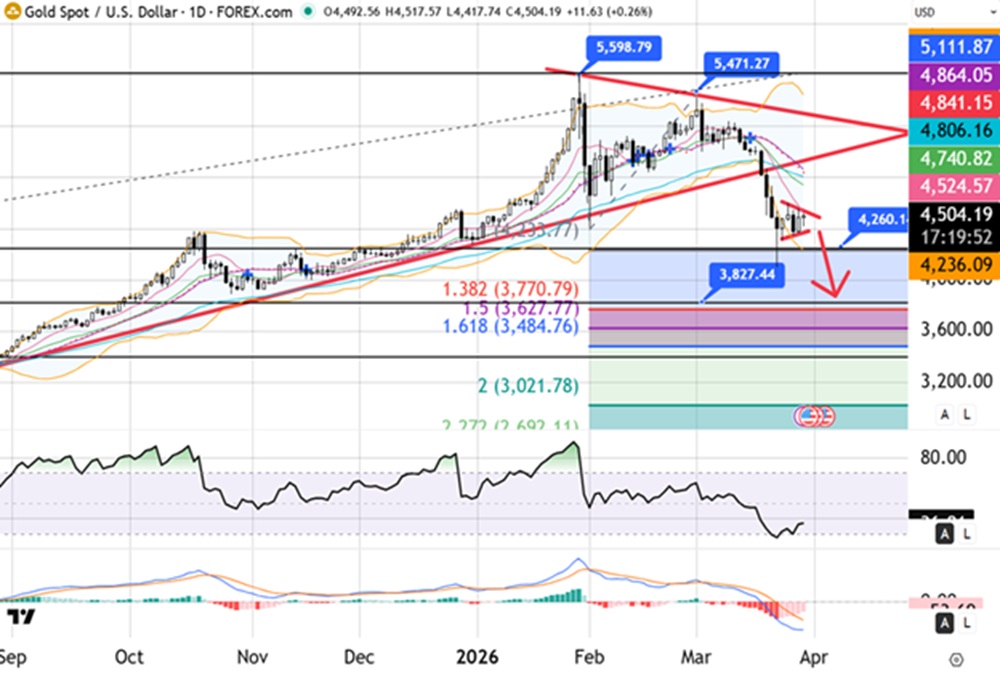
Technical View: $4504.19. Weekly chart structure indicates that while holding above 4325, a mean-reversion recovery towards 4730 is possible, where it is likely to face resistance. A turn lower from there may complete the final leg of the correction, with expected downside getting truncated near 4300 or max 4145; an extension below 4095 can expose 4015/3860 or even lower if momentum sustains.
Silver
Silver fell nearly 2% toward $68 per ounce on Monday, reversing gains from the previous session as the Middle East conflict entered its fifth week with no clear resolution in sight. Hostilities in the region intensified as Iran-backed Houthi militants in Yemen joined the conflict, targeting Israel over the weekend. The militant group also has the capacity to strike vessels transiting the Red Sea and key Saudi Arabian energy infrastructure. Meanwhile, the US military is reportedly preparing for weeks of ground operations in Iran after additional troops arrived in the region. Silver is currently down almost 30% from its March peak as the oil price shock stoked inflation concerns and reinforced expectations for interest rate hikes from major central banks. Markets are now pricing in a potential rate increase from the Federal Reserve this year, a sharp reversal from earlier expectations for two rate cuts.
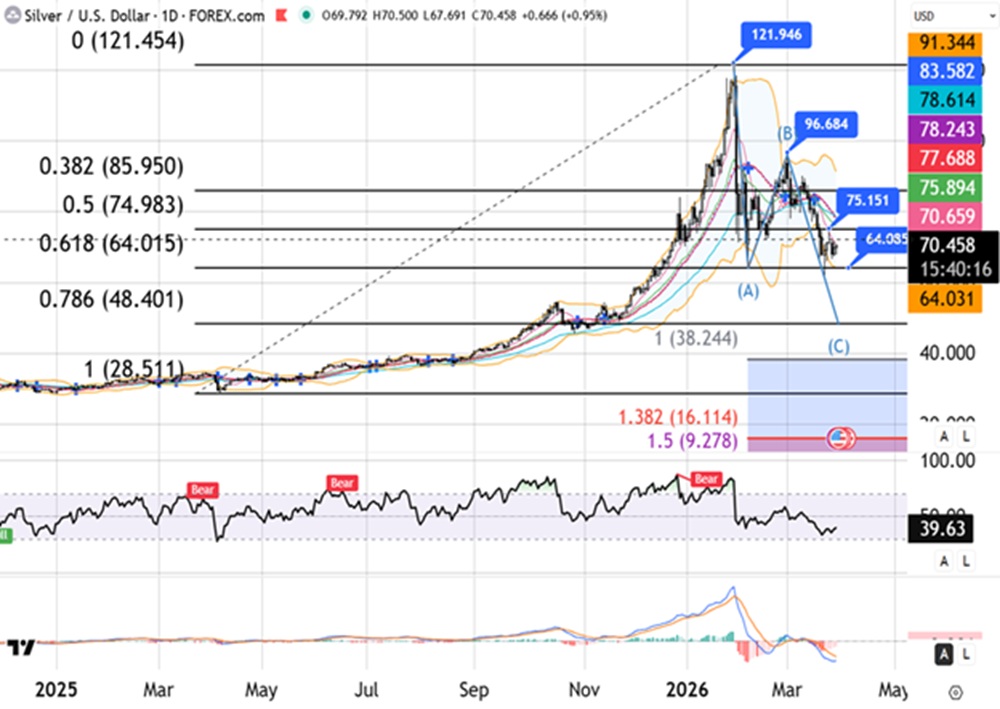
Silver May: $70.06. Resistance seen at $73-75 where upticks can cap for a fall to $64/60 levels. Above $77 can negate our bearish outlook.
Crude Oil
Crude oil started the week more than 3% higher, and remaining at its highest level since July 2022 when Russia’s invasion of Ukraine disrupted energy markets. As the war in Iran entered its fifth week, investors grew increasingly doubtful about the prospects for a swift resolution, particularly after Iran-backed Houthi militants in Yemen joined the conflict and additional US troops were deployed to the region. The Houthi militants in Yemen have threatened shipping through the Red Sea, ANZ Research analysts say in a research report. "Saudi Arabia has managed to get around the effective closure of the Strait of Hormuz by utilising its east-west pipeline to get up to" 6 million barrels per day of oil to the international market through the Red Sea, the analysts note. Front-month WTI crude oil futures are 2.8% higher at $102.43 per barrel; front-month Brent crude oil futures are 2.6% higher at $115.53 a barrel.
Technical View:
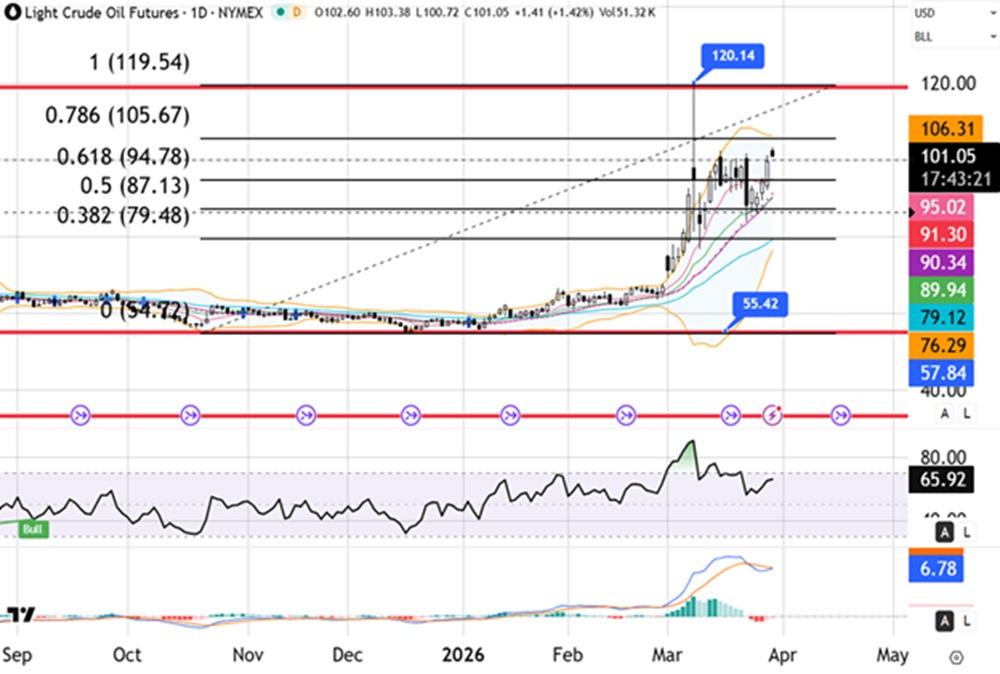
CRUDE: $101.05. Weekly structure suggests conditions are building for a spike towards $119, though the indicators show likelihood of a sideways consolidation for another week. Daily chart shows strong supports near 88.50/84.50. An unexpected fall below 84.25 can expose it to a critical support at 80.00, below which the bullishness may abate, with the next major support at 77.65.
Copper
Copper rose above $5.5 per pound on Friday and was set for its first weekly gain since the Middle East conflict began, supported by hopes for a diplomatic resolution between the US and Iran. President Donald Trump extended the deadline to strike Iranian energy infrastructure by 10 days to allow for negotiations, adding that Iran had permitted 10 oil tankers to pass through the Strait of Hormuz this week as a gesture of goodwill. However, reports indicated the Pentagon is considering sending up to 10,000 additional ground troops to the region, giving the White House more options at the negotiating table. Copper and other metals have come under pressure this month as disruptions from the conflict and surging energy prices heightened concerns over inflation and slowing global industrial activity.
Technical View:
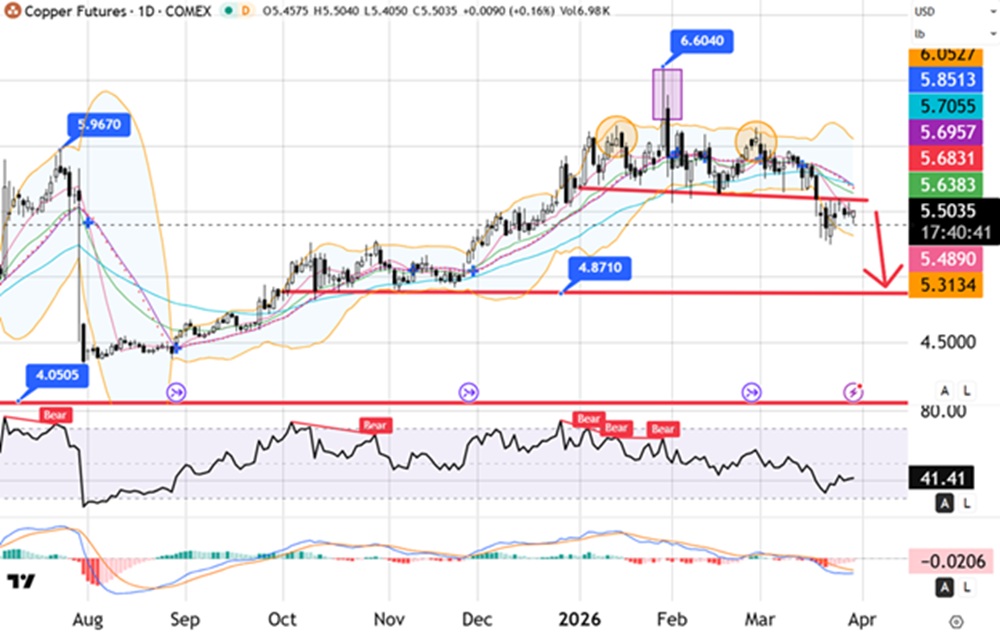
Copper: $5.50. Upticks can get capped at resistance levels $5.65/5.70. Price is likely edge lower towards $4.85/80 if momentum sustains. Unexpected rise above $5.90 could negate the bearish view.