In our earlier Ecowrap (dated 24.08.2026), we highlighted the problem of “chalk and cheese” while anlaysing the
August policy document, Governor statement and the subsequent MPC minutes. We found divergent signals from
these statements despite originating from the same institution/source. However, the situation has got changed in the
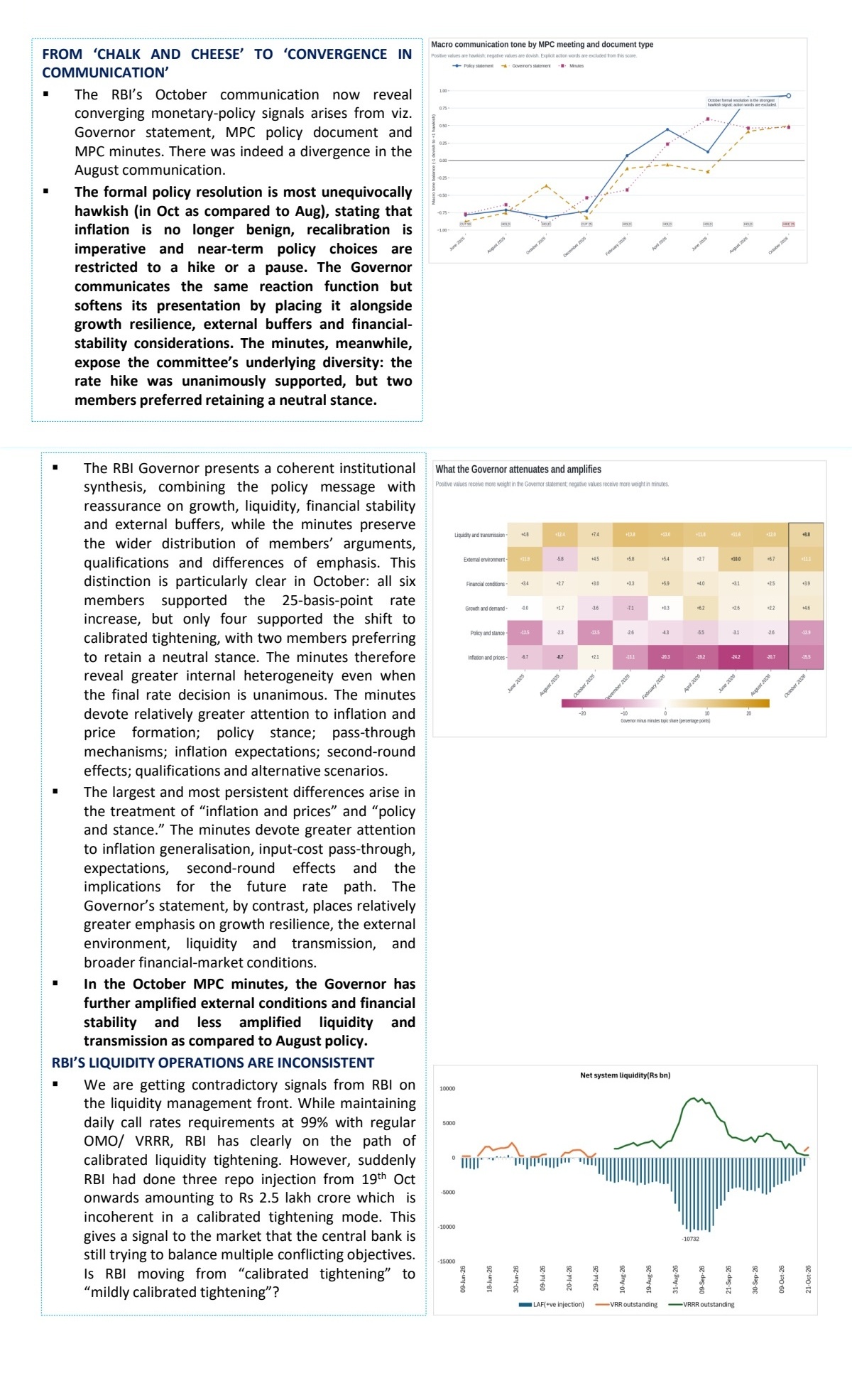
October policy. The formal policy resolution is most unequivocally hawkish (in Oct as compared to Aug), stating that
inflation is no longer benign. All six members has voted for the 25-basis-point increase to 5.50. There is least
communication puzzle now with a common tightening decision is translated seamlessly across the (policy statement,
Governor statement and MPC minutes).
The RBI Governor presents a coherent institutional synthesis, combining the policy message with reassurance on
growth, liquidity, financial stability and external buffers, while the minutes preserve the wider distribution of
members’ arguments, qualifications and differences of emphasis. In fact, in the October MPC minutes, the Governor
has further amplified external conditions and financial stability and less amplified liquidity and transmission as
compared to August policy. This clearly shows that RBI is cognizant more of threat to external stability arising from
widening geopolitical conflicts even as a rate hike was resorted to with inflation concerns taking centre stage.
We, however, find it a little difficult to understand the reasons behind RBI move to inject liquidity through repo
auctions of Rs 2.5 lakh crores even as the primary objective is to ensure that the RBI is in a “calibrated tightening”
mode and RBI Governor also emphasizing less on liquidity in October policy. The RBI has indeed done a fine balancing
act by moving the operating rate to the top end of the policy corridor and that’s exactly what should be the policy
signaling in a tightening cycle. This move has also ensured that currency has in fact appreciated by 2% from the lowest
level at Rs 96.8 from May 20th levels and a marginal 0.1 depreciation from March 31, 2026 levels.
While the move to inject liquidity and even the move to cancel all Treasury bill auctions may be interpreted by the
markets as attempts by RBI to fine tune yield movements even as US yields have declined to below 5%, we believe
Indian G-sec yields are unlikely to decline (7.6% at the higher end for now) and the current spread now at 250 basis
points is finally getting normalized. A 7.5% GDP growth in Q2GDP looks imminent. Also, the decline in US yields is
because of the auction calendar at US treasury that reveals the auction of next 10-year treasury is only on Nov 10th,
the same time when US election results will be out. Thus, a rally in 10-year US treasury will be imminent and it’s just a
lull before the storm. For example, at the recent US 20 year auction the cut off was 5.47% with bid to cover was at
2.73 indicating significant interest in US treasury at the long end. With crude oil prices set to remain at elevated levels
domestic yields are unlikely to decline even as RBI may have given a contradictory signal on liquidity. We believe,
while concerns on financial stability may have played a part, but it is better for RBI to stay away from two-way
liquidity management policy of both injection and withdrawal simultaneously as a two-way policy is applicable only
to exchange rate management policy. We continue to espouse for a widening of the LAF corridor that will be an
automatic de facto stabilizer in times of uncertainties.