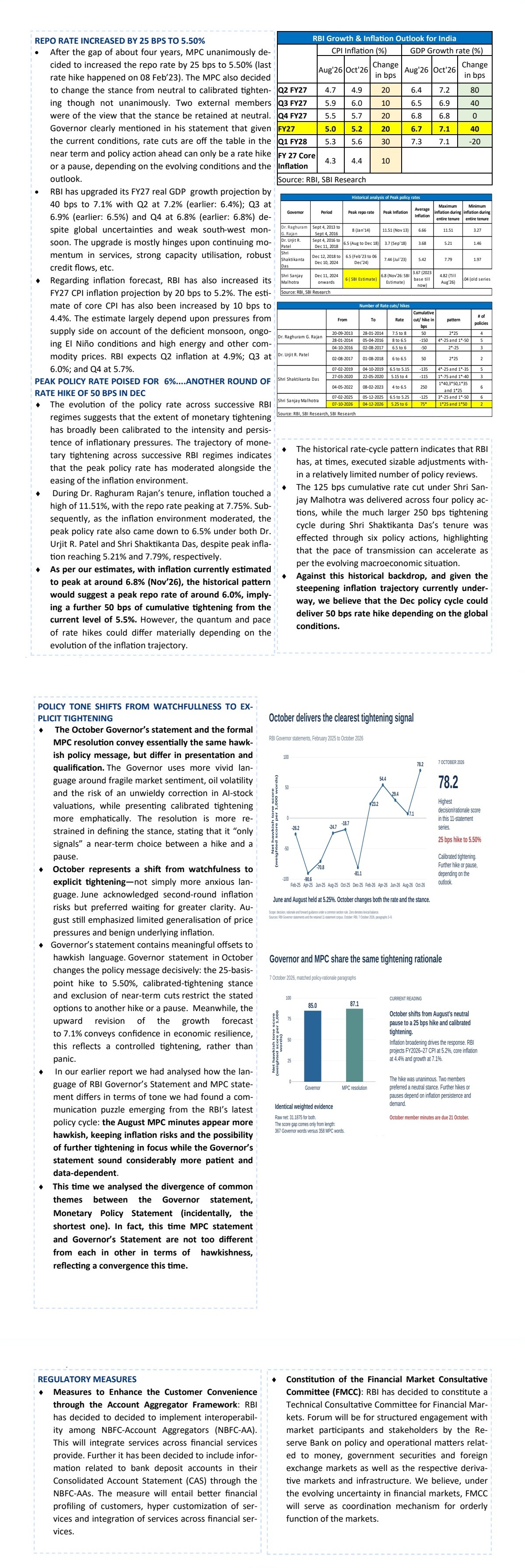
The RBI’s MPC delivered a decisive policy message today... a unanimous 25 bps increase in the repo rate to 5.50%, marking the first rate
hike in about four years. More importantly, the rate action was accompanied by a shift in the policy stance from neutral to calibrated
tightening.
Rate cuts are off the table in the near term… policy choice ahead is now effectively restricted to rate hike or pause,
depending on the evolving inflation-growth dynamics. RBI has raised projection for both GDP growth (by 40 bps to 7.1%) and CPI
inflation (by 20 bps to 5.20%) for FY27.
We believe that Q2FY27 GDP growth is likely to touch 7.5%.
Beyond the rate action itself, we believe the October policy communication represents a transition from watchfulness to explicit
tightening. Our analysis of the Governor’s Statement and the Monetary Policy Statement reveals a marked convergence in their degree
of hawkishness this time around... a significant change from the communication divergence that we had identified in the previous policy
cycle. In our earlier report, our NLP analysis had highlighted a communication puzzle in the RBI’s policy cycle (The “Chalk and Cheese”
problem in monetary policy). Our reading of the Governor’s Statement suggests that it is more vivid and risk-heavy in its presentation,
with greater emphasis on fragile market sentiment, oil-price volatility and the possibility of an unwieldy correction in AI-stock valuations.
The MPC resolution, in contrast, is more restrained, effectively stating that the current stance only signals a near-term choice between a
hike and a pause.
Furthermore, India needs a clear AI policy to facilitate capital flows. Without a clear policy, capital flows in unlikely. Thus the need of
hour to provide guardrails for rupee that is effectively moving towards a dreaded benchmark now.
Peak policy rate poised for 6%..our estimates now point towards a jumbo rate hike of 50 bps hike (or off cycle?). Our analysis of
historical RBI policy cycles suggests that the extent of monetary tightening has broadly been calibrated to the intensity and persistence
of inflationary pressures. Interestingly, as the inflation environment moderated across successive RBI regimes, the peak policy rate also
tended to moderate. Against this historical backdrop, our estimates suggest that with inflation currently expected to peak at around
6.8% in November 2026, the corresponding peak repo rate could be around 6.0%. However, the quantum and pace of rate hikes could
differ materially depending on the evolution of the inflation trajectory.
The pace of the tightening cycle is equally important. Our assessment of previous policy cycles shows that the RBI has, at times,
delivered sizeable adjustments through a relatively limited number of policy reviews. The 125 bps cumulative rate cut under Shri
Sanjay Malhotra was delivered through four policy actions, while the much larger 250 bps tightening cycle during Shri Shaktikanta Das’s
tenure was effected through six policy actions. Given the steepening inflation trajectory currently underway, we believe that the Dec
policy cycle could mostly deliver a jumbo 50 bps rate hike depending on the global conditions. Given that global conditions are likely
to turn volatile soon, the window of opportunity of RBI rate hike in small increments must be avoided. A 6% repo rate by December
could be the best possible option.
Meanwhile, in order to support rupee (which plunged 5-months low today), we propose certain measures:
- First, the plight of rupee, accentuated by flight of capital from overseas investors as Dollar strengthens rapidly (Debt outflows
totalled $2.1 bn in Sep.) needs further countercyclical policy measures beyond Debt segments… Patient capital in equity may be
incentivized through a minimized Long Term capital gains graded structure beyond a reasonable period say 3 years and beyond
(with some parity for domestic investors too) while STCG structure may also be tweaked intermittently, commencing progressively.
- Second, Mint Street should look at widening the effective interest rate corridor by hiking the MSF rate decisively higher (even if
for a shorter period) to without touching the policy rate (along similar lines as it had tweaked in April’20 and it need not wait for
another MPC meet for this).
- Third, for such action like widening the rate corridor to be effective, taking a leaf from the RBI’s Oct’26 MPR, RBI should continue
focussing on liquidity management through conventional tools of OMOs/VRRs instead of resorting to CRR. CRR as an instrument of
active liquidity management is expensive to administer and “using reserve requirements to fine tune the money supply is like
trying to use a jackhammer to cut a diamond” [Mishkin 1997].
- Fourth, the export realization and repatriation period in FC (not when Rupee settled) needs a clear revisit and a shorter period of six
months should be the norm (against currently 9 months in vogue), with higher period an exception only allowed on a case-to-case
basis to deter withholding pattern.
- Fifth, the evolving situation warrants an agile and tactile response on rate front and that may warrant a jumbo rate hike in the next
policy (or, off cycle should the fist come to a blow).