Mr. Gnansekhar
Teaser: Gold fell on Friday and was on track for a weekly loss after stronger-than
expected US jobs data raised hopes that the Federal Reserve will hike interest rates
as early as this month, undermining the appeal of non-yielding bullion. U.S. job
growth accelerated rapidly in August, while the unemployment rate remained
unchanged at 4.1%, indicating a still solid labour market and keeping the Federal
Reserve's interest rate hike this month on the table. Short-term interest rate futures
pricing currently indicate a 65% possibility of an increase in the US policy rate at the
Fed's September 15-16 meeting, up from around 55% prior to the Bureau of Labour
Statistics data. The focus now switches to next week's US consumer and producer
price inflation statistics, which could shed more light on the Federal Reserve's policy
course.
Introduction:
Gold and silver enter the week under pressure after stronger-than-expected US
employment data reinforced expectations of a possible September Federal Reserve
rate hike, supporting the dollar and Treasury yields. Attention now shifts toward US
producer inflation on Thursday and consumer inflation on Friday, which could
materially reshape expectations ahead of the September 15–16 Fed meeting.
Persistent inflation would maintain pressure on non-yielding bullion. However,
escalating US-Iran hostilities, including renewed attacks around the Strait of Hormuz,
continue to strengthen safe-haven demand. Concerns surrounding US fiscal
sustainability and elevated long-term Treasury yields also remain supportive
structurally. For the coming week, gold and silver are therefore likely to remain highly
sensitive to inflation data, yields and the dollar, while intensifying Middle East
tensions provide an important counterbalance to tighter monetary-policy
expectations. WTI enters the week with renewed strength after gaining nearly 10%
last week, as escalating US-Iran hostilities reversed earlier expectations of improving
flows through the Strait of Hormuz. Tit-for-tat attacks on vessels, including US strikes
on Iranian oil tankers, have reduced traffic through the waterway and revived
concerns over prolonged Middle East supply disruptions. Brent has consequently
returned toward $97/barrel, while WTI is trading above $92. Iran’s plans for an
exclusion zone near Hormuz add another layer of uncertainty. For the coming week,
Hormuz vessel movements, further US-Iran military action and prospects for renewed
diplomacy will remain the dominant drivers. US inflation data and Federal Reserve
expectations will also matter through their impact on the dollar and demand
expectations, but geopolitical supply risks currently remain the market’s primary
focus.
Gold
Gold traded near $4,400 an ounce on Monday after declining about 1% in the
previous session, pressured by growing expectations of an imminent Federal Reserve
interest rate hike following stronger-than-expected US jobs data last week. Data
released Friday showed US nonfarm payrolls rose by 162,000 in August, following an
upwardly revised increase of 23,000 in July and well above market expectations for
a gain of 56,000. Meanwhile, the unemployment rate remained unchanged at 4.1%,
while annual wage growth slowed to 3.1%, although the decline was smaller than
economists had expected. Markets increased bets on a September Fed rate hike to
roughly 60%, up from around 50% before the data release. Gold also remained under
pressure from higher oil prices as the US and Iran exchanged strikes on ships over
the weekend, stoking concerns about renewed inflationary pressures.
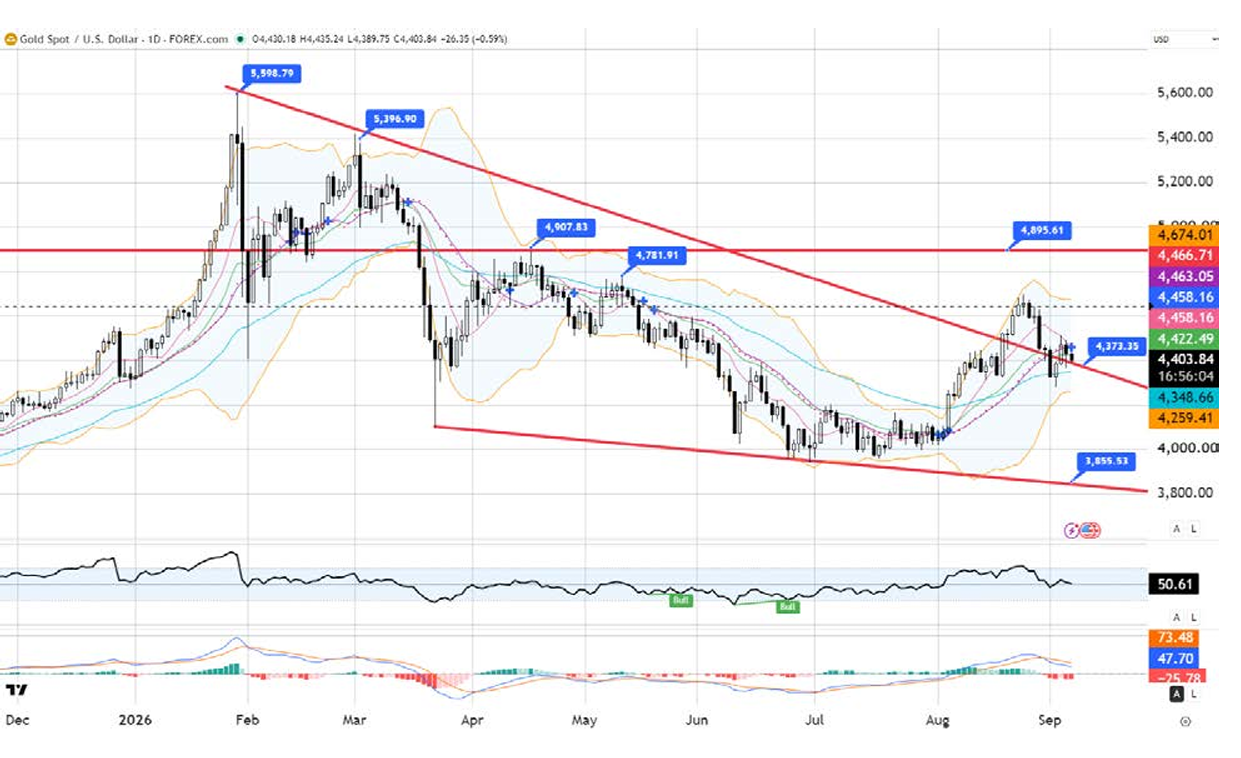
Technical View: A classic pivotal upturn on the chart favors an advance
towards 4650(MCX:161000) and 4735(MCX:163950), provided price clears
critical resistance at 4560(MCX:157900). Key downside support rests near
4350(MCX:150600). However, an unexpected dip below 4275(MCX:148030
) invalidates the bullish case, opening the risk of further weakening towards
major weekly support at 4250(MCX:147150)
Silver
Silver traded near $66 an ounce on Monday after losing more than 1% in the previous
session, pressured by growing expectations of an imminent Federal Reserve interest
rate hike following stronger-than-expected US jobs data last week. Data released
Friday showed US nonfarm payrolls rose by 162,000 in August, following an upwardly
revised increase of 23,000 in July and well above market expectations for a gain of
56,000. Meanwhile, the unemployment rate remained unchanged at 4.1%, while
annual wage growth slowed to 3.1%, although the decline was smaller than
economists had expected. Markets increased bets on a September Fed rate hike to
roughly 60%, up from around 50% before the data release. Silver also remained
under pressure from higher oil prices as the US and Iran exchanged strikes on ships
over the weekend, stoking concerns about renewed inflationary pressures.
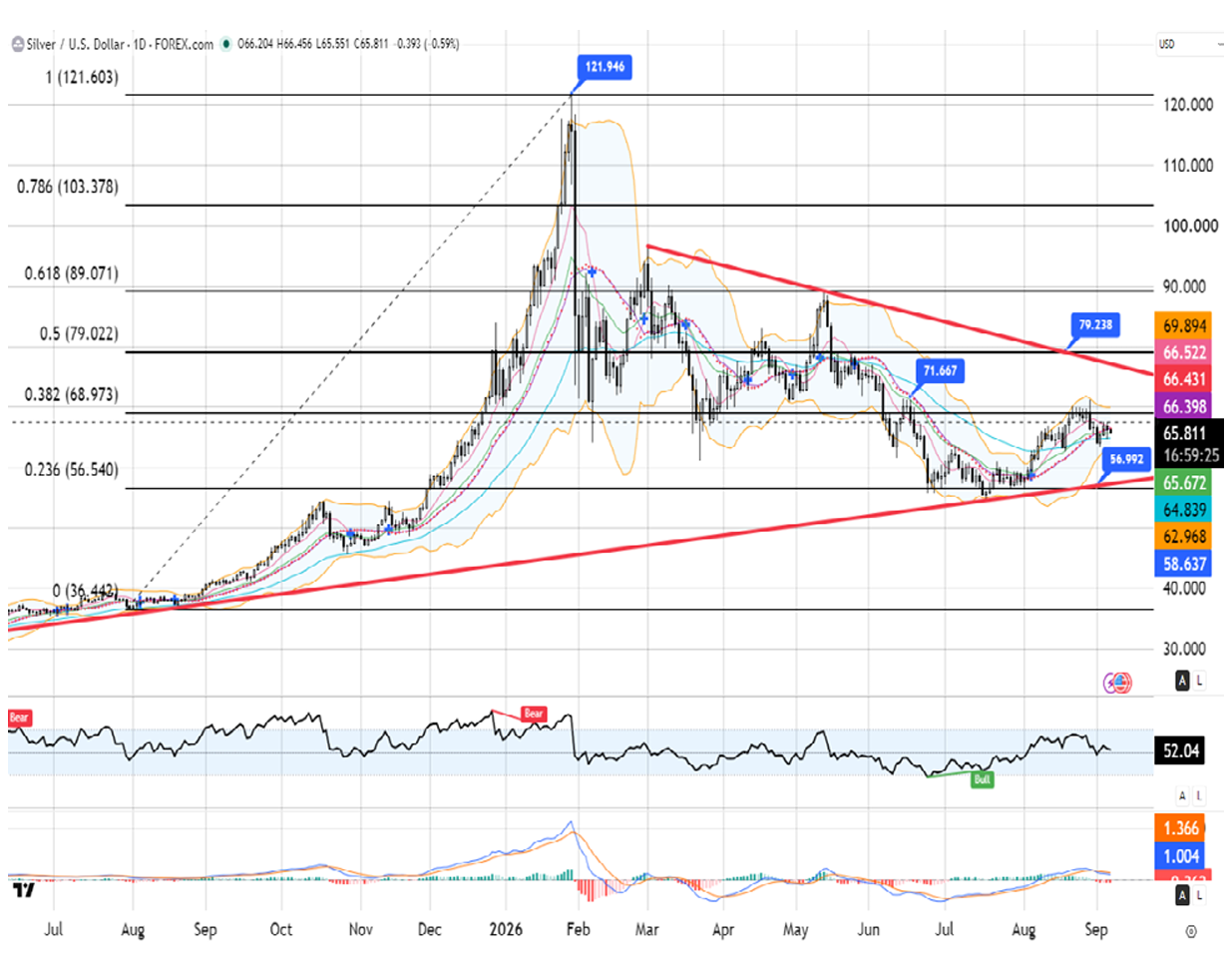
Technical View: Rallies to be capped around the $67(MCX:241650) zone for
a
move to $78/79(MCX:281300/284800). Unexpected fall below
$65.00(MCX:234400) could postpone the bullishness.
Crude Oil
Crude oil rose above $92 per barrel on Monday, extending last week’s gains as the
US and Iran exchanged strikes in the Middle East, fueling concerns over prolonged
disruptions to energy flows from the region. The US targeted three Iranian oil tankers
over the weekend in retaliation for ballistic missile attacks on US Navy warships. In
response, Tehran said a new restricted zone would be established outside the Strait
of Hormuz, including a US Navy blockade line and extending into parts of the Persian
Gulf. Meanwhile, US Energy Secretary Chris Wright said the US would maintain its
naval presence in the Middle East, including the blockade designed to curb Iranian oil
exports and help ensure the safe passage of commercial vessels through Hormuz.
Fighting between the two sides resumed last week after roughly a month of relative
calm, pushing oil prices about 10% higher as markets reassessed geopolitical and
supply risks.
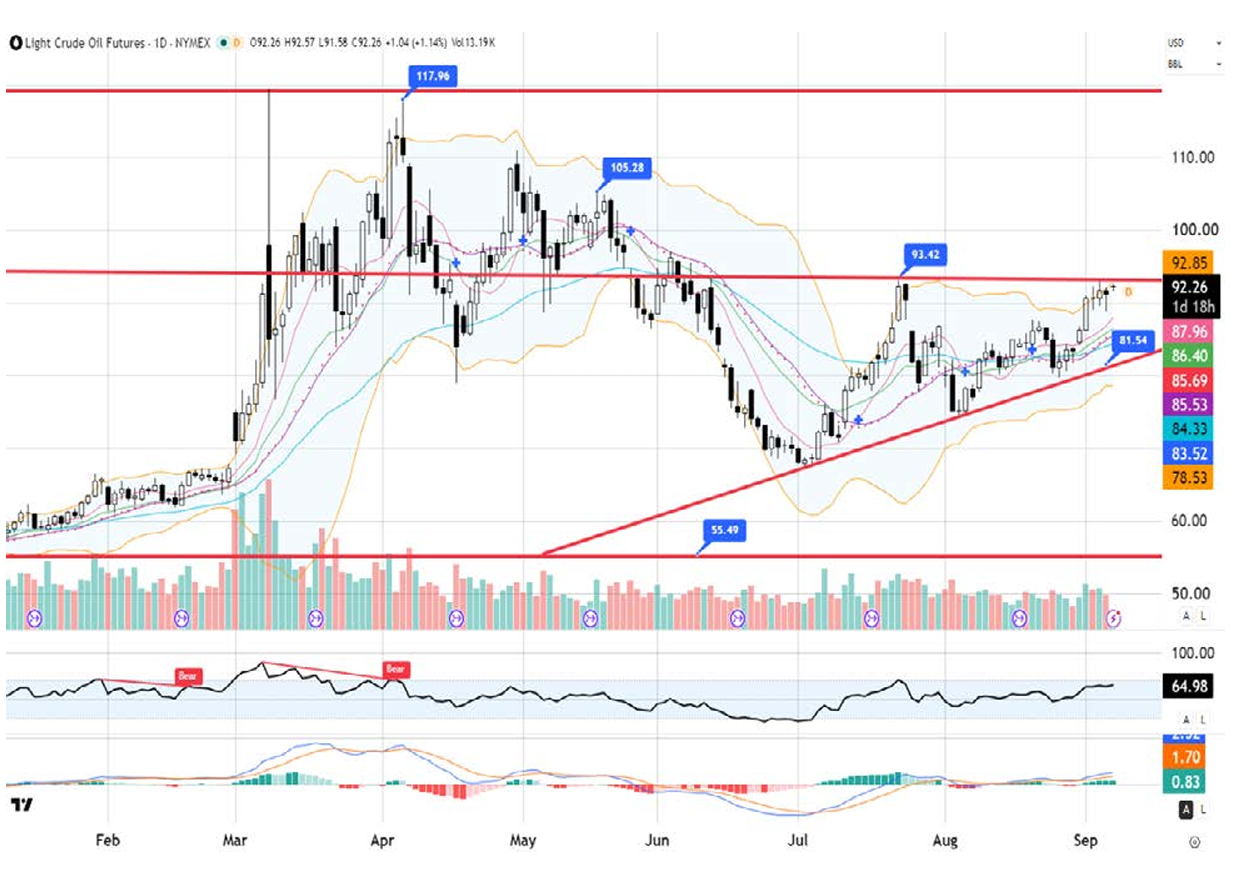
Technical View: Weekly and daily charts present a bullish structure favoring
a rise towards objectives at 94.50(MCX:8915) and 95.00(MCX:8965).
Primary supports rest around 89.85(MCX:8475) and 88.50(MCX:8350).
However, an unexpected fall below 85.50(MCX:8065) shifts the outlook
neutral, while a deeper break under 84.40(MCX:7960) hints at the risk of
landing on major support near 82.20(MCX:7750)
Copper
Copper futures slipped to around $6.55 per pound on Monday, ending a two-day rally
as stronger-than-expected US jobs data strengthened expectations for a Federal
Reserve rate hike this month, weighing on the demand outlook for industrial metals.
Investors also assessed rising inflation risks after oil prices extended their gains as
the US and Iran exchanged strikes on ships over the weekend. Still, copper remained
near record highs amid persistent concerns over supply. Analysts pointed to a recent
export ban in Congo, weaker production from major producers Chile and Peru, and
disruptions associated with El Nino. Data showed top producer Chile recorded its
weakest second-quarter output in at least 19 years. The country also lowered its full
year production forecast for a second consecutive quarter and now expects output to
decline 2.6%. Elsewhere, uncertainty over tariffs continues to encourage copper
shipments into the US, pushing Comex inventories to record levels.
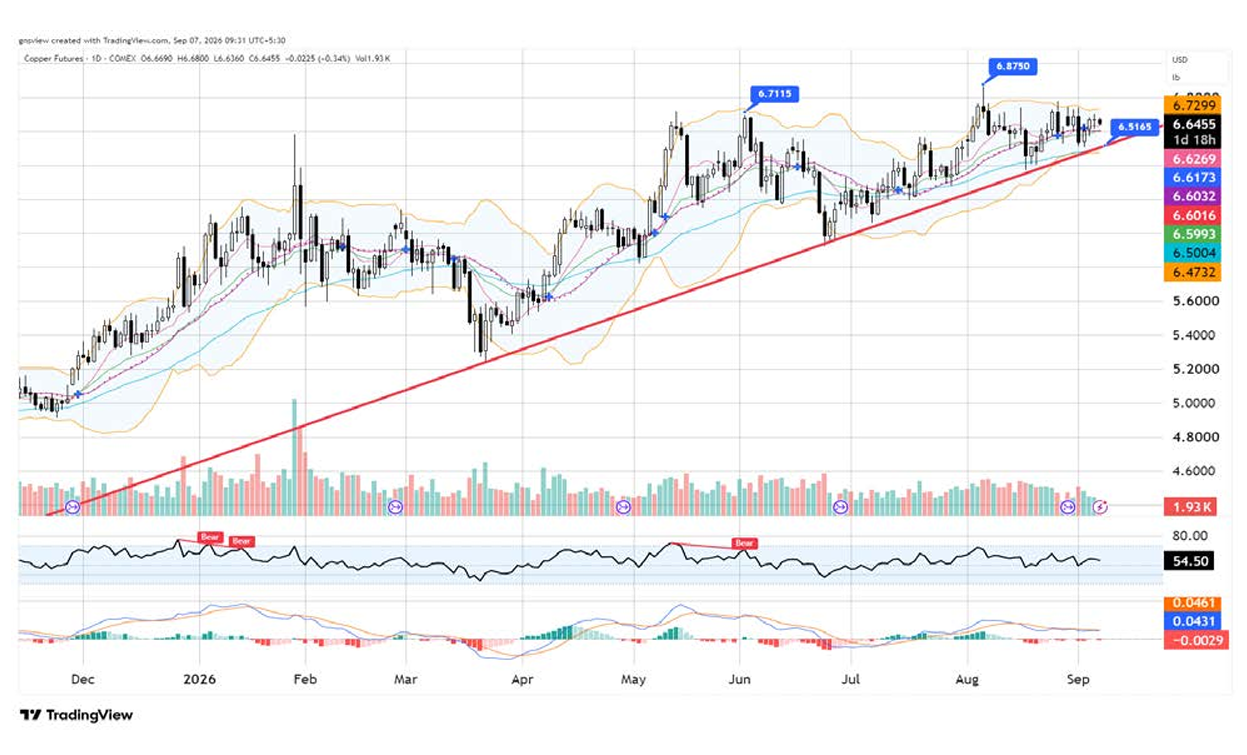
Technical View: Price could likely edge lower to near term supports at
6.57/60(MCX:1365/1372). While supports hold we can expect a test of
6.85(MCX:1400) or even higher. Favored view is mildly bearish in the near
term, however, the broader bullish bias is still intact. Unexpected fall below
6.51(MCX:1358) critical trendline support can turn the picture negative.