Teaser: Gold futures fell after Fed Chairman Kevin Warsh highlighted concerns about underlying inflation, which caused shorter-term Treasury yields to climb. The fundamental environment remains favourable for gold, while the market has become more sensitive to predictions about US monetary policy. Following today's dip, gold has fallen 2.9% this week, retreating from Tuesday's more than three-month high of $4,696.18. According to the CME FedWatch tool, traders now estimate a 58% chance of a US rate hike in September, up from 36% before Warsh's comments, and an 89% chance of an increase in December. Gold loses appeal in a high-interest rate situation because it provides no yield. Gold discounts in India plunged this week, as demand fell sharply on market speculation that the government could consider rolling back a recent hike in import duties.
Introduction:
Gold and silver faced a sharp correction, as hawkish Federal Reserve signals and higher Treasury yields pressured non-yielding bullion. Fed Chair Kevin Warsh highlighted persistent inflation risks, strengthening expectations of further policy tightening and pushing gold and silver lower during the previous week. However, concerns over US fiscal sustainability and Treasury efforts to contain long-term borrowing costs remain important underlying supports for precious metals. Geopolitical uncertainty also persists after Washington intensified sanctions against Iran, keeping safe-haven considerations relevant. For the coming week, attention shifts toward US employment data, Treasury yields and the dollar, which will influence expectations for September monetary policy. Gold and silver therefore face near-term pressure from tighter-rate expectations, while fiscal concerns and geopolitical risks provide an important counterbalance. WTI enters the week after falling more than 4% last week, as improving crude flows through the Strait of Hormuz and Iran-Oman negotiations reduced immediate supply-disruption concerns. Reports of a potential framework for managing shipping through the waterway encouraged expectations of further normalization, although vessel movements remain inconsistent and US-Iran diplomacy remains unresolved. Meanwhile, Washington has intensified sanctions against Iran, preserving geopolitical uncertainty. Ukrainian attacks on Russian refineries continue to threaten refined product availability and provide a supply-side counterweight. US crude inventories increased only 95,000 barrels in the latest reported week, substantially below expectations, limiting bearish inventory pressure. For the coming week, Hormuz traffic, Iran-related sanctions, Russian refinery disruptions and Federal Reserve expectations should remain central, with improving Gulf flows competing against persistent geopolitical supply risks.
Gold
Gold traded around $4,460 an ounce on Monday after tumbling more than 3% in the previous session, as hawkish remarks from Federal Reserve Chair Kevin Warsh revived expectations for an imminent interest rate hike. In his Jackson Hole address on Friday, Warsh warned that inflation is not easing significantly and reaffirmed the central bank’s commitment to bringing inflation back to its 2% target, while noting that financial conditions are not currently restrictive. Markets are now pricing in around a 57% chance of a 25-basis-point Fed rate hike in September, up sharply from roughly 40% a week earlier. Gold also remained pressured by rising oil prices after the US military targeted Iranian rocket launchers preparing to deploy mines into the Strait of Hormuz, marking the first such attack in more than a month. Still, the metal is on track to gain over 10% for the August, driven in large part by the so called debasement trade.
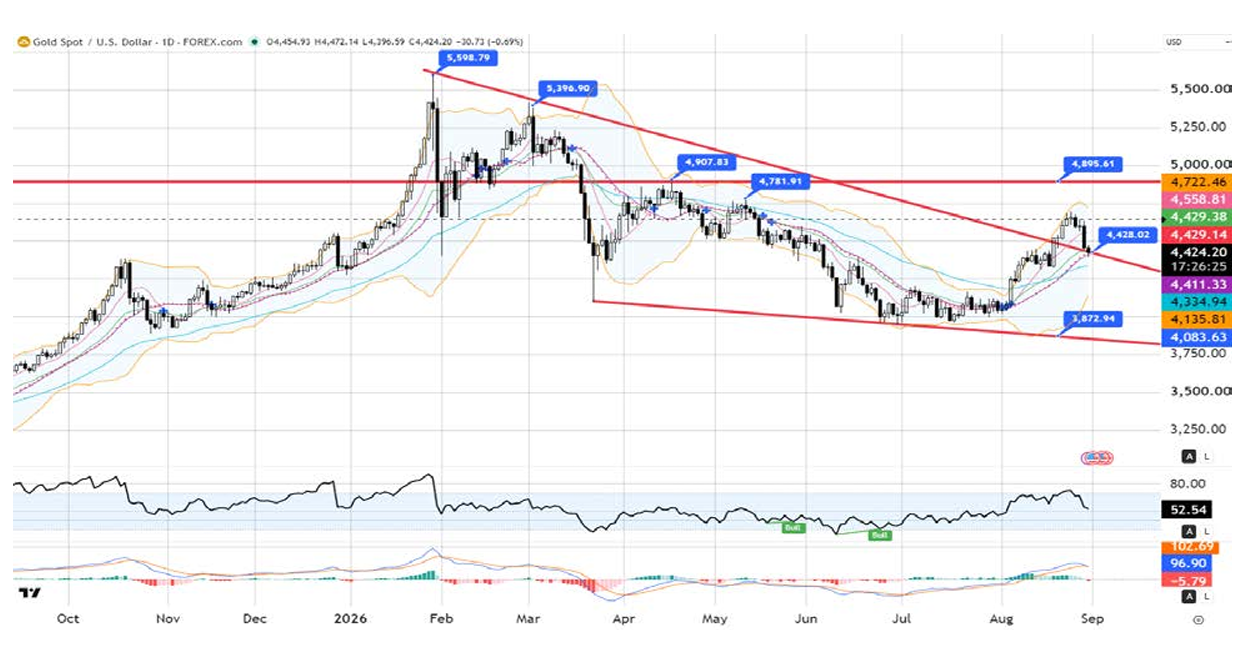
Technical View: The completion of the rally from 3959.77(MCX:139801) to 4697(MCX:164773) targets a corrective decline towards the 4335/4310(MCX:151000/150150) support zone. Primary resistance holds near 4565(MCX:159000), while support rests between 4335(MCX:151000) and 4310(MCX:150150). A breakdown below 4246(MCX:147950) extends weakness towards 4102(MCX:142900), whereas an unexpected rally above 4650(MCX:161950) invalidates the sharp drop into sideways consolidation.
Silver
Silver traded around $66.4 an ounce on Monday after losing more than 4% in the previous session, as hawkish remarks from Federal Reserve Chair Kevin Warsh revived expectations for an imminent interest rate hike. In his Jackson Hole address on Friday, Warsh warned that inflation is not easing significantly and reaffirmed the central bank’s commitment to bringing inflation back to its 2% target, while noting that financial conditions are not currently restrictive. Markets are now pricing in around a 57% chance of a 25-basis-point Fed rate hike in September, up sharply from roughly 40% a week earlier. Silver also remained pressured by rising oil prices after the US military targeted Iranian rocket launchers preparing to deploy mines into the Strait of Hormuz, marking the first such attack in more than a month. Still, the metal is on track to gain over 15% for the August.
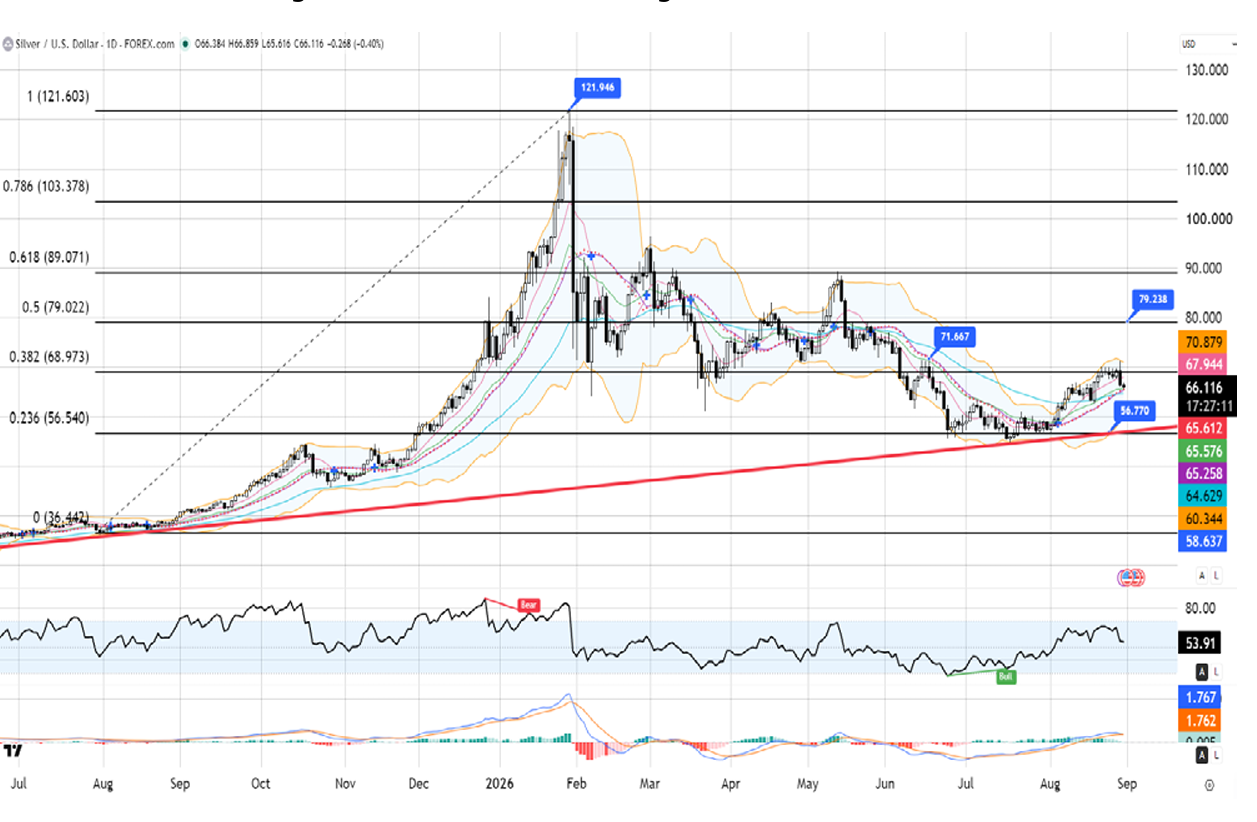
Technical View: Only a decisive break above 71(MCX:256400) can see prices test $78/79(MCX:281800/285400). Favored view is neutral near term. Supports at $62/61(MCX:224000/220550). Unexpected fall below $60(MCX:217000) could drag prices lower to deeper supports at $57(MCX:206150).
Crude Oil
Crude oil climbed toward $85 per barrel on Monday, starting the week higher after the US military targeted Iranian rocket launchers preparing to deploy mines into the Strait of Hormuz, marking the first such attack in more than a month. US forces also said they are closely monitoring the waterway and remain prepared to safeguard the free flow of commerce. The US last launched missiles at Iranian targets in late July but has since shifted its focus toward squeezing the country’s economy through sanctions to push Tehran back to the negotiating table. An Iranian official said Friday that resuming diplomacy with the US “isn’t impossible” following constructive discussions with Qatar, a mediator in the conflict. Meanwhile, reports indicated that around 6 to 8 million barrels of crude are still flowing through Hormuz each day despite the absence of a peace agreement between Washington and Tehran.
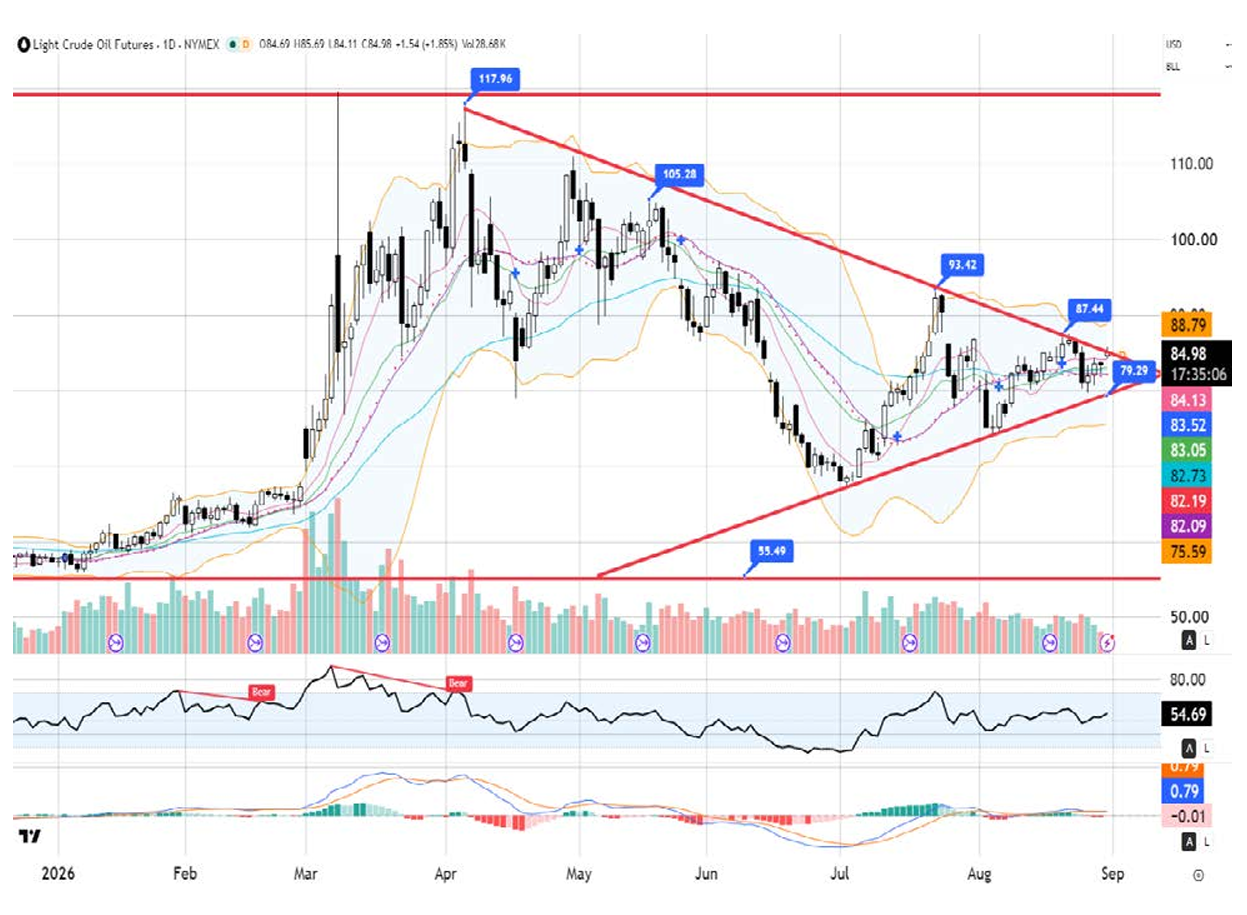
Technical View: Price is targeting an initial recovery towards near-term resistances at 86.50(MCX:8265) and 87.60(MCX:8370). Key supports between 80.95(MCX:7735) and 80.45(MCX:7685) are expected to cushion pullbacks to preserve upside scope. A decisive break down below the critical risk point at 79.60(MCX:7605) invalidates the bullish setup, exposing the contract to 78.60(MCX:7510).
Copper
Copper futures eased to around $6.55 per pound on Monday, falling for a fourth straight session as the dollar strengthened amid growing expectations that the Federal Reserve will raise interest rates next month following hawkish remarks from Chair Kevin Warsh. A stronger dollar makes greenback-priced commodities such as copper more expensive for buyers using other currencies, weighing on near-term demand. There were also signs that the supply squeeze may be easing, with the premium for spot copper over three-month futures narrowing. Additionally, LME inventories have improved recently as metal deliveries increased. However, traders continued diverting copper shipments toward the US ahead of potential new import tariffs, tightening supplies in global markets. Mining disruptions in major producers Indonesia, Congo and Chile also added to concerns over supply.
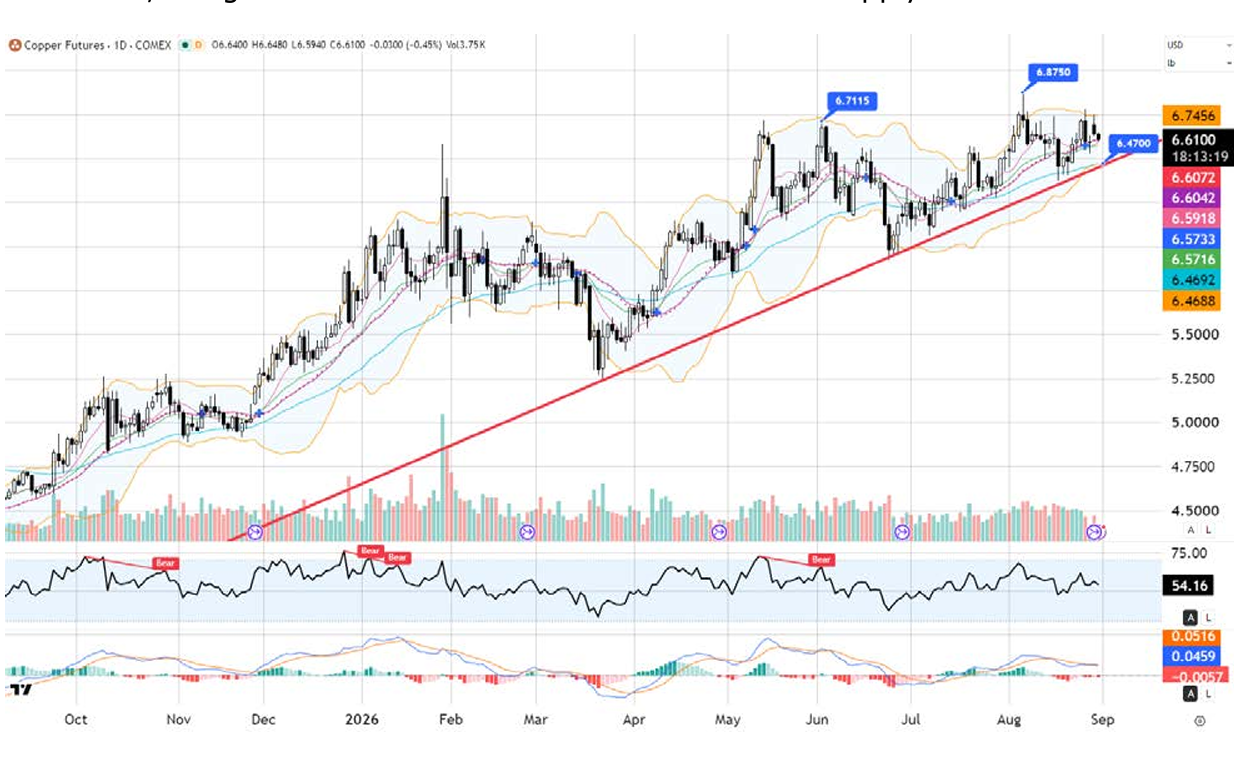
Technical View: Price could likely edge lower to near term supports at 6.52/55(MCX:1380/1383). While supports hold we can expect a test of 6.85(MCX:1418) or even higher. Favored view is neutral in the near term. Unexpected fall below 6.47(MCX:1375) critical trendline support can turn the picture negative.