Mr. Gnansekhar
Teaser: Gold advanced on Friday and was headed for a weekly gain, buoyed by a
weaker dollar after in-line U.S. inflation readings this week tipped the scales in favor
of an interest rate pause by the Federal Reserve next month. Gold drew support from
an unexpected decline in U.S. nonfarm payrolls in July, and inflation readings this
week that were largely in line with expectations. This significantly lowered
expectations of an increase in interest rates next month, with most analysts now
seeing the central bank holding the current 3.50% to 3.75% range. Markets are
pricing in a 33% chance of a rate hike in September versus 55% last week, CME's
FedWatch Tool showed. Meanwhile, transit thru the Strait of Hormuz appeared to
come to a halt after two more ships were targeted, and the US announced that it
may maintain a naval blockade against Iran forever.
Introduction:
Gold and silver strengthened as softer U.S. inflation reinforced the impact of July’s
weak labour-market report and reduced expectations of a September Federal Reserve
rate hike. July CPI rose modestly, while producer prices were unchanged, pushing
Treasury yields and the dollar lower and supporting non-yielding bullion. Gold
reached a high, with silver also benefiting from the improved monetary backdrop. In
the coming week, focus shifts towards the Fed’s July meeting minutes for further
guidance on policymakers’ inflation and rate outlook. Evidence of greater caution
towards tightening could extend support for precious metals, while any renewed
hawkish messaging may trigger consolidation. Persistent uncertainty surrounding
Iran, the Strait of Hormuz and Middle Eastern security risks should preserve safe
haven demand, while central-bank purchases remain an underlying support for gold.
WTI crude oil remained volatile during the previous week as stalled U.S.-Iran
diplomacy and uncertainty over reopening the Strait of Hormuz maintained a
geopolitical premium. Negotiations involving Iran and Oman advanced but failed to
produce a full reopening, while security threats kept shipping conditions fragile.
However, an exceptionally large increase in U.S. crude inventories and weaker
demand projections from both the IEA and OPEC restrained the market. Going
forward, Hormuz shipping flows and U.S.-Iran negotiations will remain dominant
drivers. Further restrictions on tanker movements, attacks on vessels or deterioration
in diplomacy could reinforce supply concerns, while progress towards reopening
would reduce the geopolitical premium. The Fed minutes, U.S. inventory data and
Chinese demand indicators matter, with weakening consumption expectations and
ample non-disrupted supply potentially limiting stronger gains despite Middle Eastern
risks.
Gold
Gold traded just below $4,400 an ounce on Monday, holding steady as investors
weighed subdued US economic data that reduced expectations for an imminent
Federal Reserve rate hike against persistent tensions in the Middle East. Data
released last week pointed to tame US inflation, while consumer sentiment and retail
sales weakened. Markets now see roughly a one-in-three chance of a Fed rate hike
in September, down from nearly 50% before the data. Investors are now awaiting
the FOMC’s latest meeting minutes and Fed Chair Kevin Warsh’s speech at the
Jackson Hole symposium for further guidance. Meanwhile, tensions in the Middle East
remain elevated after Israel launched fresh strikes on Lebanon over the weekend,
while President Donald Trump is preparing new economic sanctions aimed at forcing
Iran to surrender. Still, Middle Eastern producers are covertly moving millions of
barrels of crude through the Strait of Hormuz.
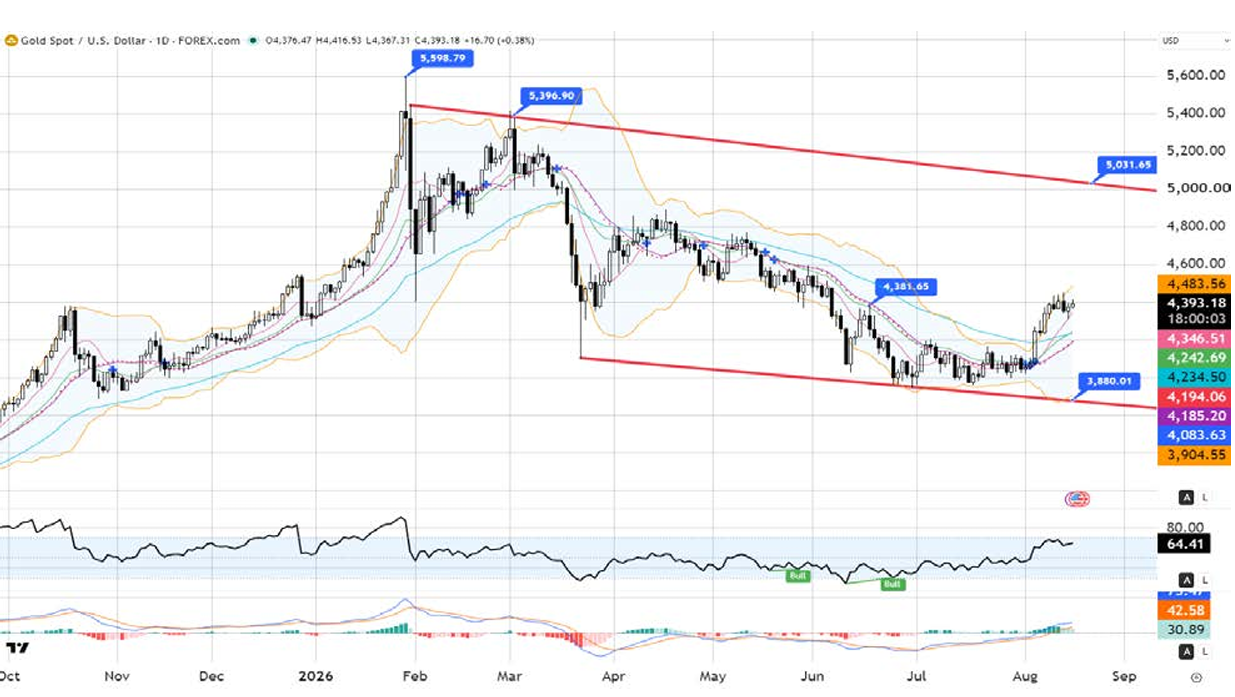
Technical View: Holding below $4425(MCX:156200) keeps the preferred
view tilted toward a mild dip to 4235(MCX:149500) to form a base, while a
break below 4205(MCX:148450) risks exposing 4060(MCX:143300). A move
above the weekly super trend at 4490(MCX:158550), which is the risk point,
would reduce the chance of a fall and strengthen the case for an extension
toward 4530(MCX:159850) and later 4700(MCX:165900)
Silver
Silver rose toward $66 an ounce on Monday, extending gains from the previous
session as subdued US economic data reduced expectations for an imminent Federal
Reserve interest rate hike. Data released last week pointed to tame US inflation,
while consumer sentiment and retail sales weakened. Markets now see roughly a
one-in-three chance of a Fed rate hike in September, down from nearly 50% before
the data. Investors are now awaiting the FOMC’s latest meeting minutes and Fed
Chair Kevin Warsh’s speech at the Jackson Hole symposium for further guidance.
Meanwhile, tensions in the Middle East remain elevated after Israel launched fresh
strikes on Lebanon over the weekend, while President Donald Trump is preparing
new economic sanctions aimed at forcing Iran to surrender. Still, Middle Eastern
producers are covertly moving millions of barrels of crude through the Strait of
Hormuz, keeping oil prices in check and easing concerns about inflationary risks.
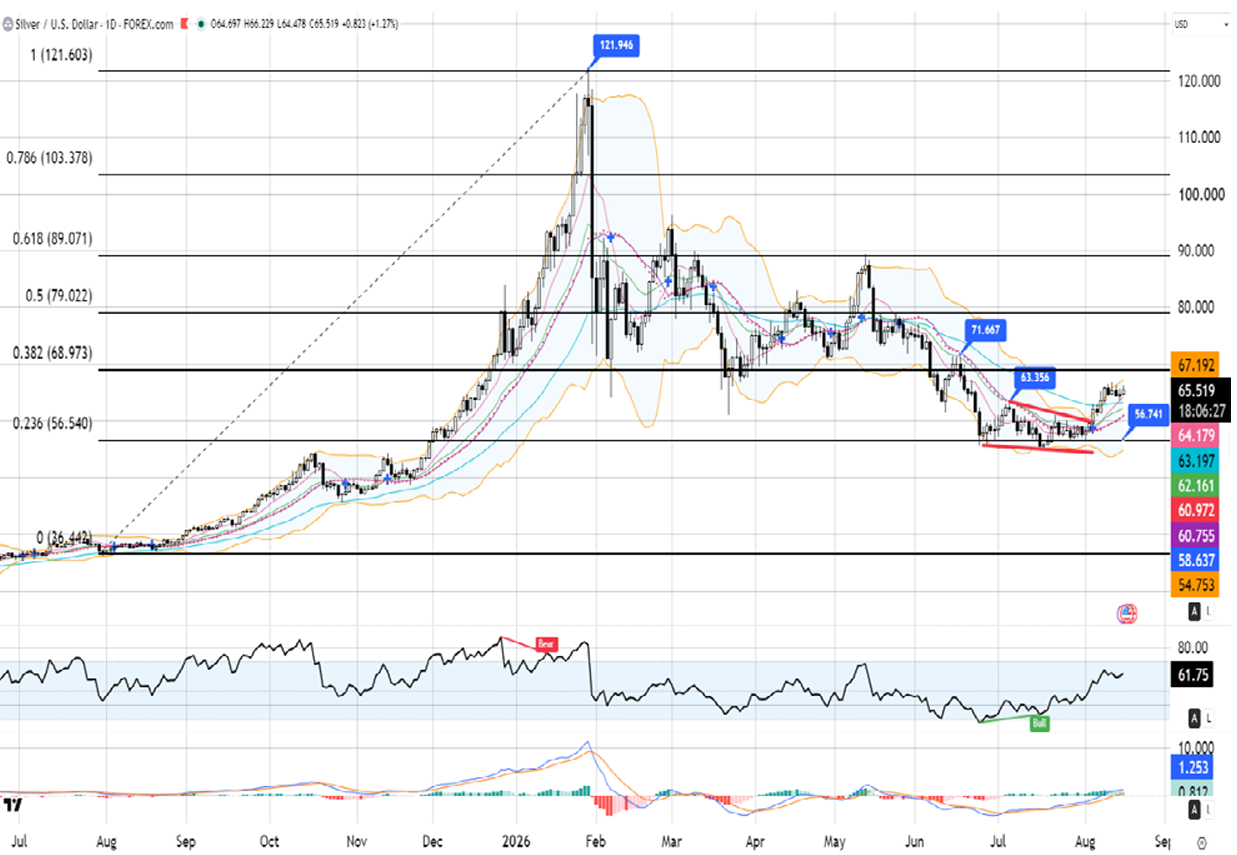
Technical View: Any dips are likely to be supported around the $62/63(MCX:224300/228000)
zone
for
a
move to
$68/70(MCX:246200/253400). Unexpected fall below $60.45(MCX:218800
) could dash our bullish hopes.
Crude Oil
Crude oil traded around $82.5 per barrel on Monday, holding onto last week’s gains
as tensions in the Middle East remain elevated, keeping markets wary of further
supply disruptions. Over the weekend, Israel launched fresh strikes on Lebanon that
killed 11 people, including a senior Hezbollah commander. President Donald Trump
is also preparing new economic sanctions aimed at forcing Iran to surrender, as
pressure mounts on his administration to bring the military campaign to an end. The
interim ceasefire agreement between the US and Iran is set to formally expire later
today, while negotiations to end the conflict and reopen the Strait of Hormuz remain
deadlocked. Meanwhile, Middle Eastern producers are covertly moving millions of
barrels of crude through the waterway, helping to limit further price gains. Iran and
Oman also appear to be moving closer to an agreement on how to manage the Strait
of Hormuz, although the US is not participating in the talks.
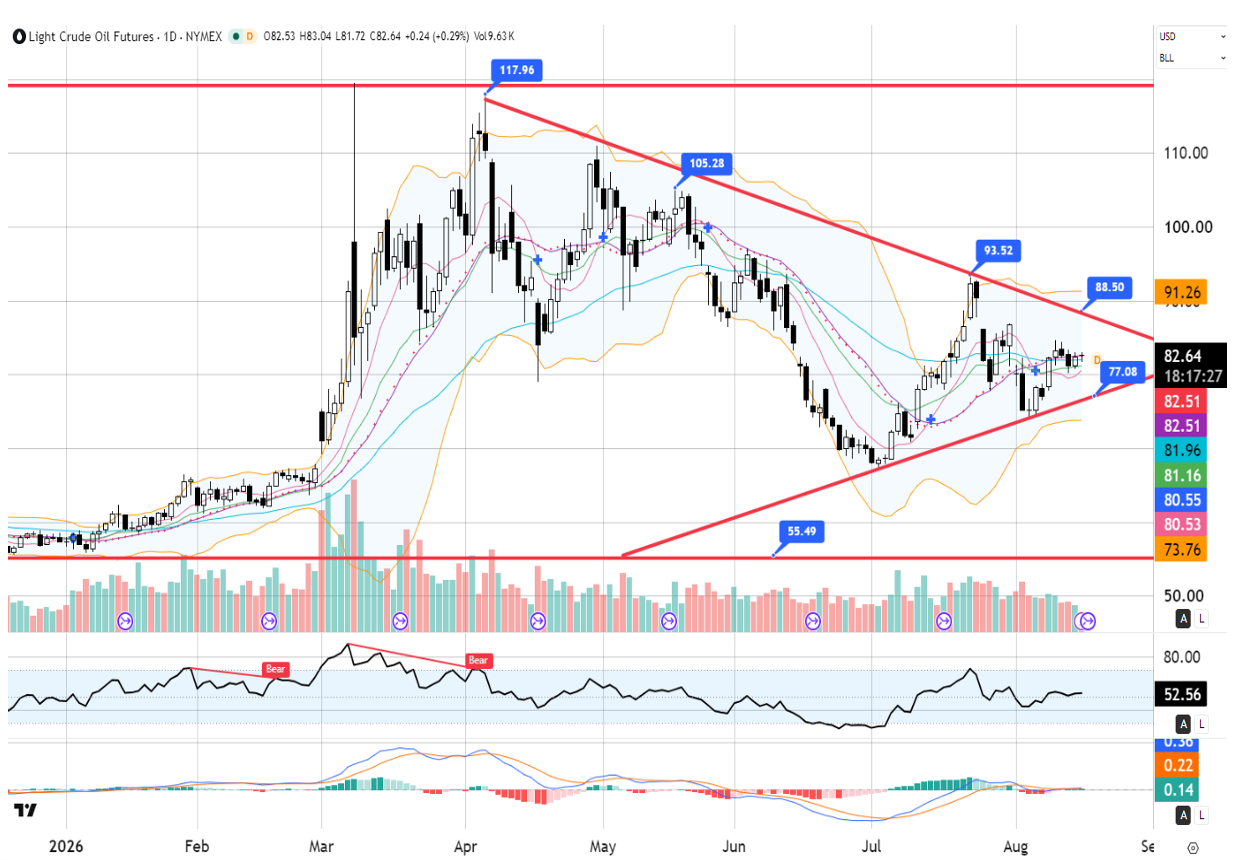
Technical View: Bullish chart structures point towards daily objectives at
$85.65/86.05(MCX:8190/8230) before extending towards the weekly
target at 89.25(MCX:8530), with solid underlying supports resting at
79.30(MCX:7585) and 78.50(MCX:7505) A break below the 78.25(MCX:7480
) risk point would cause the structure to lose its bullishness, leaving it
vulnerable to a fall towards 73.85(MCX:7060).
Copper
Copper futures jumped above $6.7 per pound on Monday, moving toward fresh record
highs amid further signs of tightening global supply. China’s refined copper output is
expected to decline for a second consecutive month in August as persistent shortages
of copper concentrate and other smelter feedstocks continue to weigh on operating
rates, highlighting increasingly tight raw material availability. At the same time,
tighter domestic tax-invoice regulations have reduced the availability of VAT
compliant recycled copper, limiting another key source of smelter feedstock and
putting further pressure on refined output. In top producer Chile, state-owned miner
Codelco reportedly expects copper production to decline this year as it faces setbacks
at its mines and development projects. Traders also remained cautious about
potential US import tariffs on copper, which have continued to divert metal away
from international markets and into US warehouses.
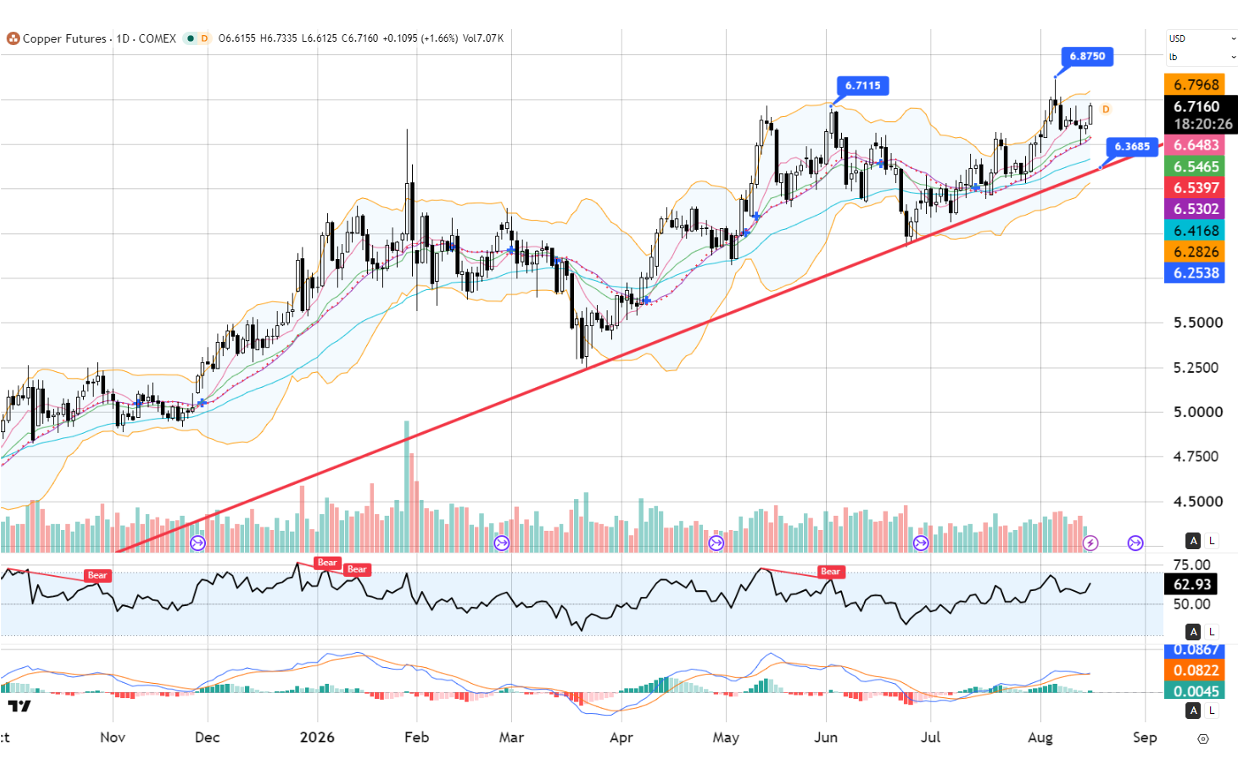
Technical View: Charts indicate a test of the next upside objective at
6.85/90(MCX:1410/1417). Favored view is bullish in the near term.
Supports at $6.55/50(MCX:1375/1367). Unexpected fall below
6.36(MCX:1350) critical trendline support can risk turning the picture
bearish.