Mr. Gnansekhar
Teaser: Gold futures rose on Friday, reaching their highest level in seven weeks,
after an unexpected decrease in US nonfarm payrolls for July crushed rate-hike
optimism and placed bullion on track for its best week in seven months. Bullion prices
are expected to jump by more than 7% this week, marking the highest weekly
increase since January 19. Declining energy prices and a potentially reduced
possibility of US interest rate increases point to a weaker dollar and higher gold
prices. According to LSEG data, the rate futures market currently expects the Fed to
tighten in September at a rate of 43.9%, down from 57% before the employment
report. The probability that the Fed will keep interest rates unchanged next month
increased to 56.1% from 43.2% before the data release.
Introduction:
Gold and silver rallied strongly during the previous week, supported by a sharp
deterioration in U.S. labour-market data that reduced expectations of another Federal
Reserve rate hike. July payrolls unexpectedly contracted by 23,000, while downward
revisions to previous months reinforced concerns over slowing economic momentum,
pushing the dollar and Treasury yields lower and strengthening demand for bullion.
Gold consequently reached a seven-week high, while silver also recorded strong
gains. Going into the week of August 10–14, attention will shift towards U.S. CPI and
PPI inflation data for further clues on monetary policy. Softer inflation could further
weaken rate-hike expectations and support precious metals, while renewed tensions
surrounding Iran and the Strait of Hormuz could provide an additional safe-haven
catalyst. Persistent central-bank demand could also provide underlying support
during corrections. WTI crude oil experienced another highly volatile week, plunging
nearly 7% on Monday after President Trump held off on fresh military action against
Iran, before recovering as uncertainty surrounding the Strait of Hormuz returned.
Iran and Oman made progress towards establishing a shipping corridor, but
disagreements over control, transit conditions and broader U.S.-Iran relations
prevented a full reopening of the strategic waterway, keeping supply risks elevated.
Going into the week of August 10–14, crude prices are expected to remain highly
sensitive to Hormuz negotiations and actual shipping flows. Progress towards
reopening could remove further geopolitical premium, while delays or renewed
attacks could quickly restore upside pressure. OPEC+ supply policy, U.S. inventories
and signs of weaker global demand will remain important secondary drivers. Chinese
demand trends could additionally influence the broader near-term price outlook.
Gold
Gold remained above $4,300 an ounce on Monday after surging more than 7% last
week, supported by an unexpected contraction in the US labor market that led traders
to reduce expectations for a near-term Federal Reserve interest rate hike. Data
released Friday showed the US economy unexpectedly lost 23K jobs in July, following
a downwardly revised 20K increase in June and falling well short of forecasts for an
80K gain. Markets now price around a 44% chance of a 25 basis point rate hike in
September, down from 67% a week earlier. Gold also held its gains even after oil
prices climbed higher as uncertainty persisted over efforts to reopen the Strait of
Hormuz. Iran said talks with Oman were close to an agreement but denied holding
direct negotiations with the US, despite Washington’s claims that a deal was
imminent.
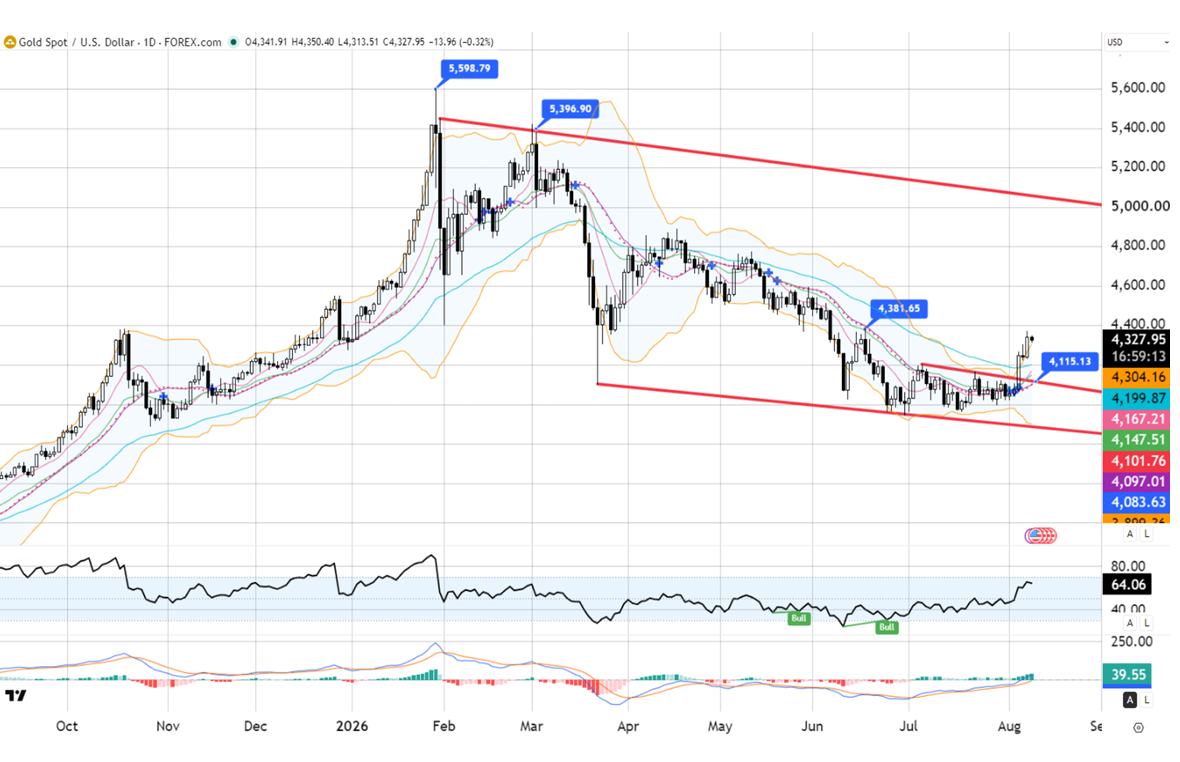
Technical View: A sharp rally out of consolidation has erased bearish
momentum, though clearing 4490(MCX:157700) remains essential to
confirm trend continuation. Daily chart structures suggest corrective dips
will find solid support near 4250/4200(MCX:149300/147500) to target the
4450/4490(MCX:156250/157700) resistance zone. Maintaining this
constructive setup depends on key levels holding; an unexpected drop below
4125(MCX:144900) invalidates the bullish stance.
Silver
Silver traded near $64 an ounce on Monday after surging more than 10% last week,
supported by an unexpected contraction in the US labor market that led traders to
reduce expectations for a near-term Federal Reserve interest rate hike. Data released
Friday showed the US economy unexpectedly lost 23K jobs in July, following a
downwardly revised 20K increase in June and falling well short of forecasts for an
80K gain. Markets now price around a 44% chance of a 25 basis point rate hike in
September, down from 67% a week earlier. Silver also held its gains even after oil
prices climbed higher as uncertainty persisted over efforts to reopen the Strait of
Hormuz. Iran said talks with Oman were close to an agreement but denied holding
direct negotiations with the US, despite Washington’s claims that a deal was
imminent.
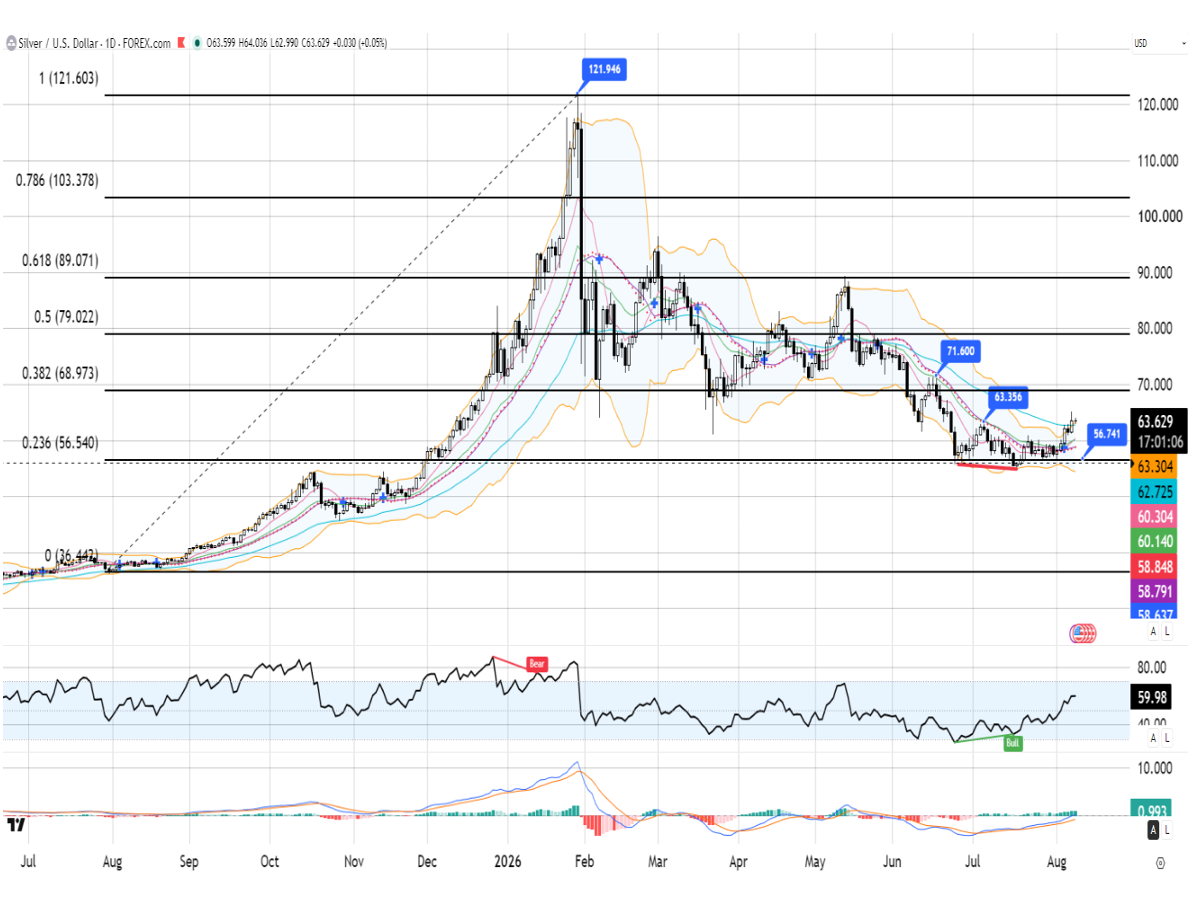
Technical View: Dips to be supported around the $63(MCX:230700) zone for
a move to $68/70(MCX:249000/256400). Unexpected fall below
$60.45(MCX:229850) could postpone the bullishness.
Crude Oil
Crude oil climbed toward $79 per barrel on Monday, marking a third consecutive
session of gains as uncertainty persisted over efforts to reopen the Strait of Hormuz.
Iran said over the weekend that talks with Oman on establishing a shipping route
through the strategic waterway were nearing an agreement, but warned that any
arrangement would not lead to an immediate reopening of Hormuz. Tehran also
rejected direct negotiations with the US for now, citing breaches of the interim peace
deal reached in June, while maintaining demands for an end to the US naval blockade,
the lifting of sanctions and compensation for war damages. Meanwhile, President
Donald Trump signalled patience amid mounting pressure on the US to reach a deal
with Tehran. Elsewhere, Iran-backed Houthi militants in Yemen claimed an attack on
Saudi Arabia’s Jazan refinery, while a tanker operated by Abu Dhabi National Oil Co.
came under attack in Hormuz over the weekend.
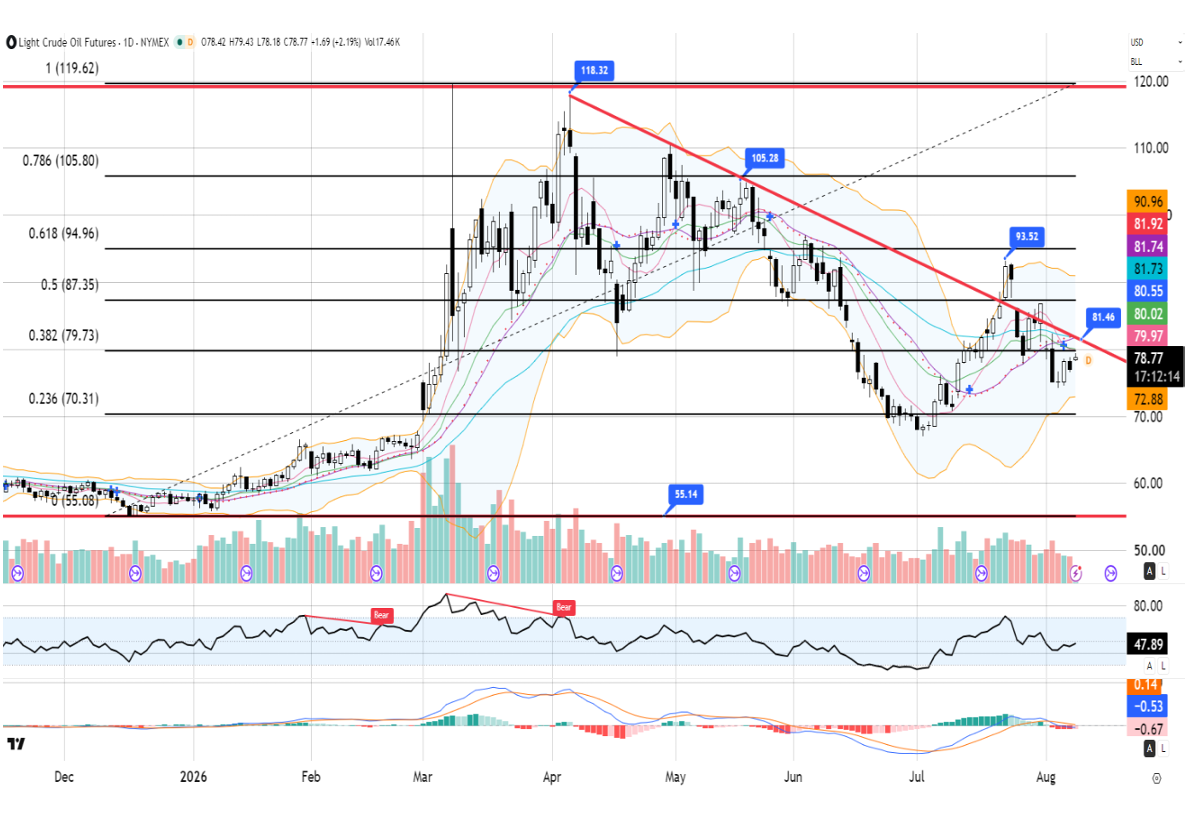
Technical View: Weekly charts show an underlying tendency to drift down,
with interim daily upticks expected to remain capped below resistance at
79.60/79.90(MCX:7575/7600) and 81.25(MCX:7745). Maintaining this
ceiling
favors a breakdown below 74.20(MCX:7070) towards
71.15(MCX:6780) and 73.00(MCX:6960). Crucially, a rise past the
82.35(MCX:7845) risk point would invalidate the bearish setup, opening
scope to challenge 85.25(MCX:8125) and 86.90(MCX:8280).
Copper
Copper futures climbed above $6.7 per pound on Friday, reaching fresh record highs
as mounting global supply risks continued to support the market. The Democratic
Republic of Congo has banned exports of copper concentrates, highlighting a growing
trend among resource-rich nations to retain more value by expanding domestic
refining and processing capacity. Concerns over potential US import tariffs on copper
also continued to divert supplies from international markets into US warehouses.
Meanwhile, operations at part of Codelco’s flagship El Teniente mine could remain
suspended for up to two years, adding to supply concerns. On the demand side,
copper remained supported by a strong outlook for power grid upgrades and data
center expansion as the global shift toward electrification and artificial intelligence
continued to drive consumption.
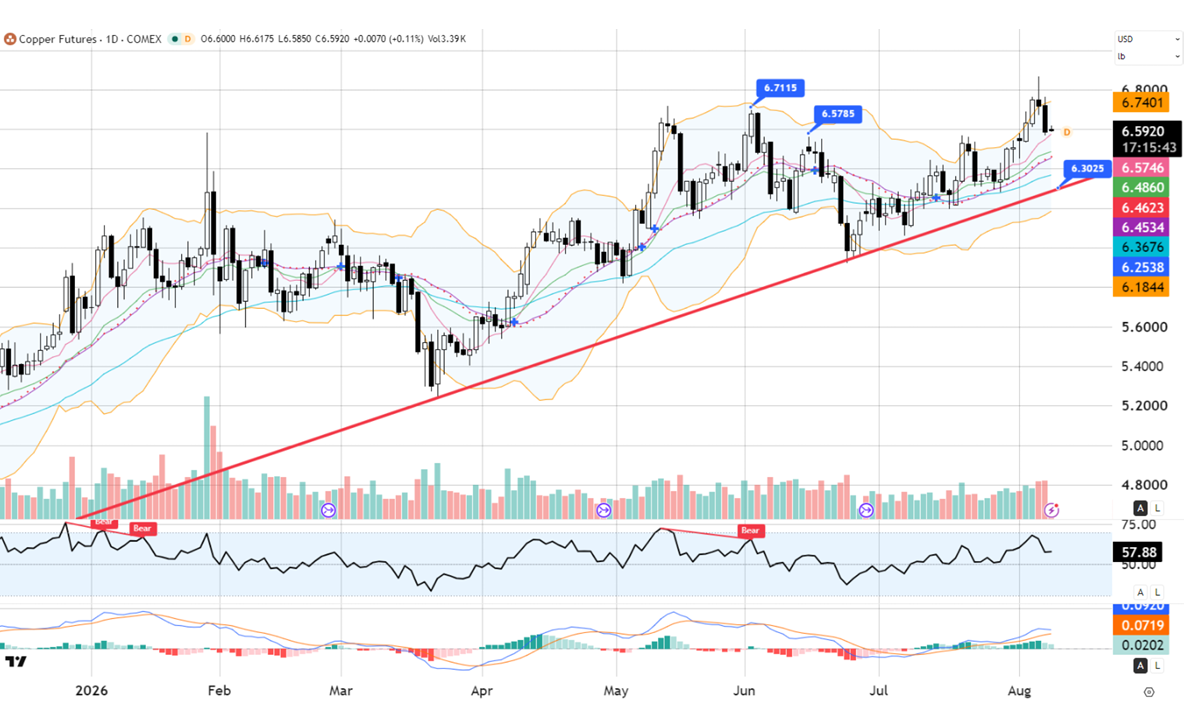
Technical View: Charts indicate a minor dip to supports where price could
likely hold for a rise. Supports at $6.45/40(MCX:1357/1350). Resistance at
$6.70/68(MCX:1385/1383). Only a decisive cross above $6.74(MCX:1390)
could likely take prices higher to $6.90(MCX:1408) or even higher. Favored
view is neutral in the near term.