Teaser: Gold futures ended July on a positive note, despite Friday's fall, which
brought gold closer to flat for the month. Silver fell 3.2% in July, to $57.591/oz.
Silver declined 2.1% during the day. Gold has gained 1.1% this month, the largest
monthly increase since February. The gains have been mostly driven by slower
inflation data, which has forced traders to lower their expectations for Federal
Reserve interest rate hikes this year, as well as oil prices returning to pre-Iran war
levels earlier this month. The dollar remained stable after falling almost 2.4% on
Thursday, its largest one-day decrease since January 2023. A higher dollar
increases the price of bullion for holders of foreign currencies. Market participants
expect a 65% chance of a rate hike in September, down from more than 80% the
week before which is positive for bullion.
Introduction:
Gold and silver recovered during the previous week after the Federal Reserve left
interest rates unchanged, while easing geopolitical tensions between the United
States and Iran pushed crude oil prices sharply lower and reduced immediate inflation
concerns. A weaker U.S. dollar also improved bullion's appeal, although expectations
that the Fed could still tighten policy later this year limited stronger gains. Physical
demand remained resilient across Asia, helping cushion downside pressure despite
elevated prices. Going into the coming week, precious metals are expected to remain
sensitive to U.S. economic data, Federal Reserve commentary and movements in the
dollar. Any renewed geopolitical tensions or weaker macroeconomic indicators could
revive safe-haven demand, while stronger economic data may reinforce higher-for
longer interest rate expectations and limit upside.
WTI crude oil began the previous week on a firm footing as renewed tensions between
the United States and Iran fueled concerns over potential supply disruptions across
the Middle East, keeping a sizeable geopolitical risk premium embedded in prices.
However, sentiment shifted sharply in the second half of the week after Washington
suspended military operations, raising hopes of a diplomatic resolution and easing
fears over shipping through the Strait of Hormuz. The retreat in geopolitical tensions,
combined with expectations of higher OPEC+ production from September and
resilient non-OPEC supply growth, encouraged broad profit-taking and pushed prices
back towards pre-conflict levels. Going into the coming week, crude prices are
expected to remain driven by developments in U.S.-Iran diplomacy, OPEC+ policy,
global inventory trends and macroeconomic data, with any renewed escalation likely
to quickly restore upside risk.
Gold
Gold climbed above $4,050 an ounce on Monday, recovering losses from the previous
session after President Donald Trump said peace talks with Iran will resume today,
sending oil prices lower and easing concerns over inflation and the interest rate
outlook. Trump said key Middle Eastern allies, including Saudi Arabia, urged him to
suspend planned strikes and pursue a diplomatic agreement instead, while reiterating
his call for the swift reopening of the Strait of Hormuz. Investors also turned their
focus to a packed week of US labour market data, highlighted by Friday’s closely
watched monthly jobs report. Last week, the Federal Reserve left interest rates
unchanged, although three officials dissented, warning that delaying action for too
long could eventually require more aggressive policy tightening. Markets are
currently pricing in about a 68% chance of a 25-basis point Fed rate hike in
September.
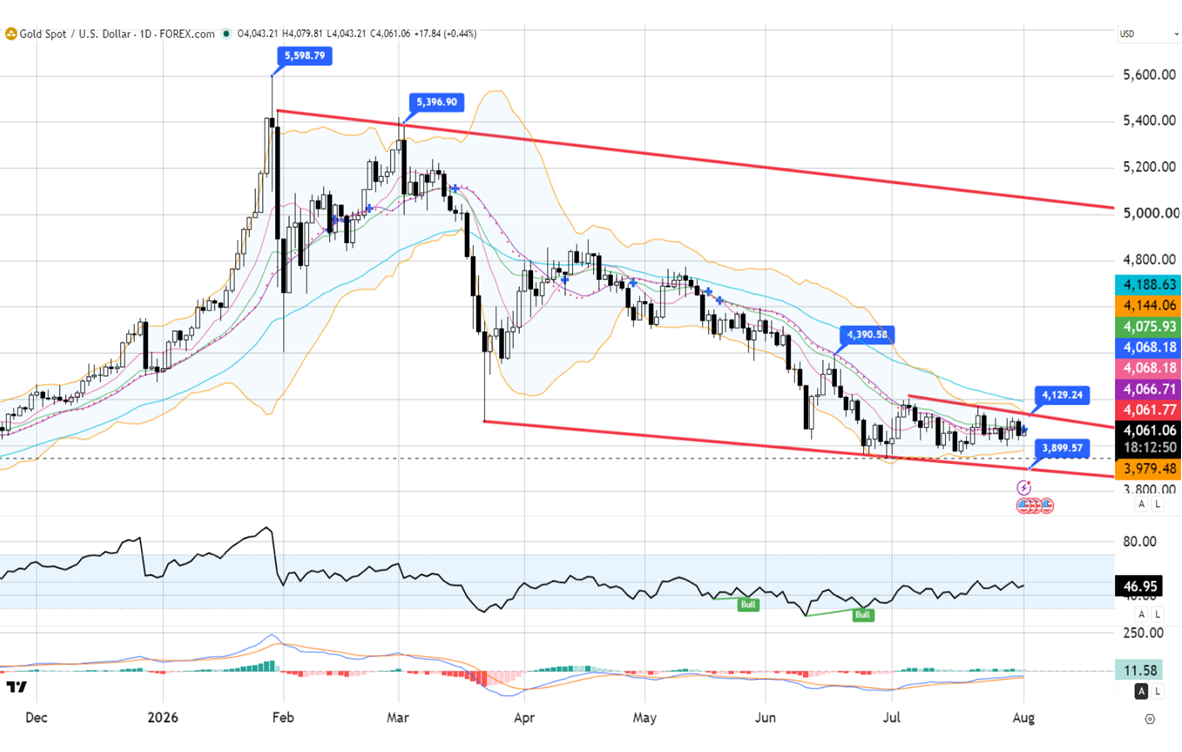
Technical View: $4061.06. The price reflects sideways consolidation across
weekly charts, favoring an eventual breakdown towards a volatility target
at 3880. Daily resistances near 4030 and 4165/4185 are expected to cap
near-term upticks. A rise above 4202 invalidates this bearish bias, clearing
space towards 4380 where little overhead resistance exists.
Silver
Silver climbed above $58 an ounce on Monday, recovering losses from the previous
session after President Donald Trump said peace talks with Iran will resume today,
sending oil prices lower and easing concerns over inflation and the interest rate
outlook. Trump said key Middle Eastern allies, including Saudi Arabia, urged him to
suspend planned strikes and pursue a diplomatic agreement instead, while reiterating
his call for the swift reopening of the Strait of Hormuz. Investors also turned their
focus to a packed week of US labour market data, highlighted by Friday’s closely
watched monthly jobs report. Last week, the Federal Reserve left interest rates
unchanged, although three officials dissented, warning that delaying action for too
long could eventually require more aggressive policy tightening. Markets are
currently pricing in about a 68% chance of a 25 basis point Fed rate hike in
September.
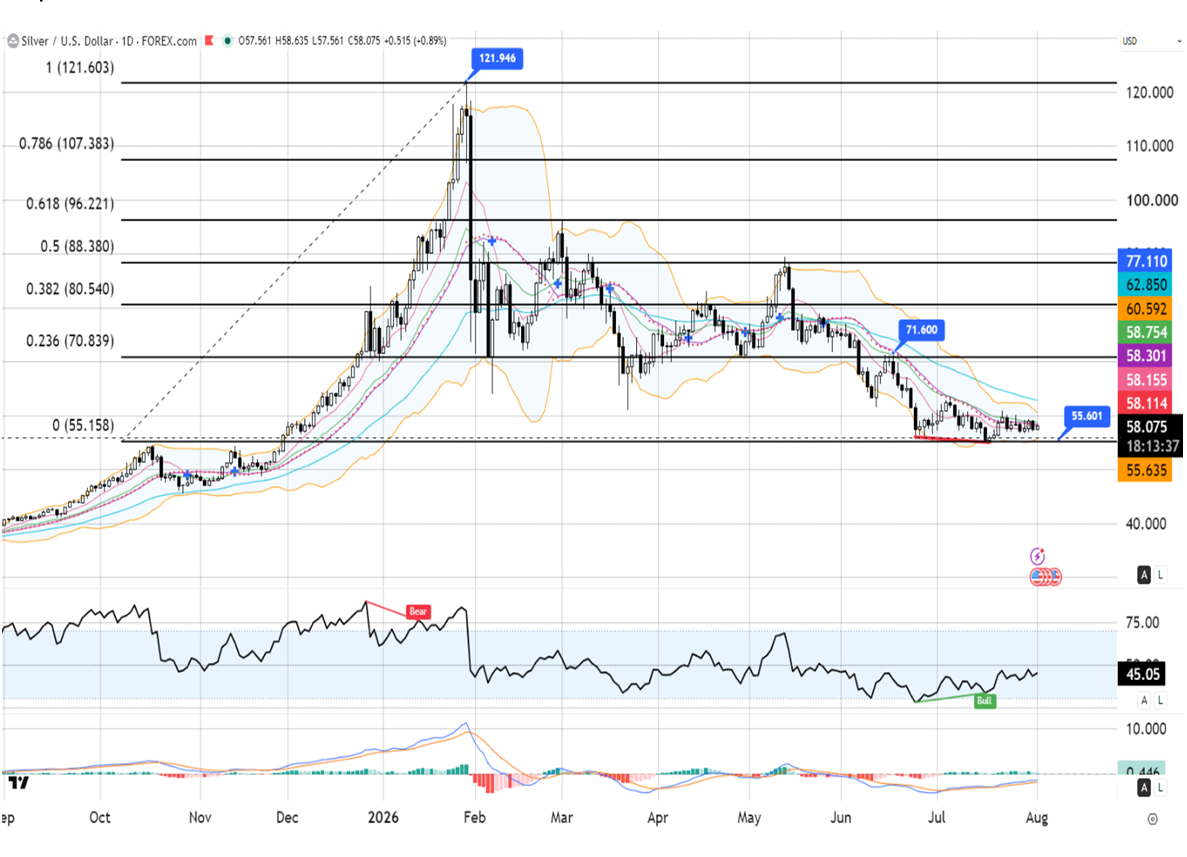
Technical View: $58.07. Rallies are likely to cap at $60.65/61.00 zone,
expect price to edge lower to $55/54. Unexpected rise above $62 could take
it to $75 levels subsequently.
Crude Oil
Crude oil dropped more than 4% toward $80 per barrel on Monday after surging over
20% in July, as President Donald Trump announced that peace talks with Iran will
resume today after he cancelled a planned military strike against the Islamic
Republic. Trump said key Middle Eastern allies, including Saudi Arabia, urged him to
suspend the attacks and prioritize negotiations, while reiterating his call for the swift
reopening of the Strait of Hormuz. Last month, oil prices climbed about 23% after
renewed hostilities between the US and Iran shattered the interim peace agreement,
with supply disruptions extending from the Strait of Hormuz to the Red Sea.
Meanwhile, major OPEC+ producers approved another modest increase in production
quotas, completing the planned restoration of output cuts introduced in 2023 and
leaving room to boost supplies further once the Middle East conflict comes to an end.
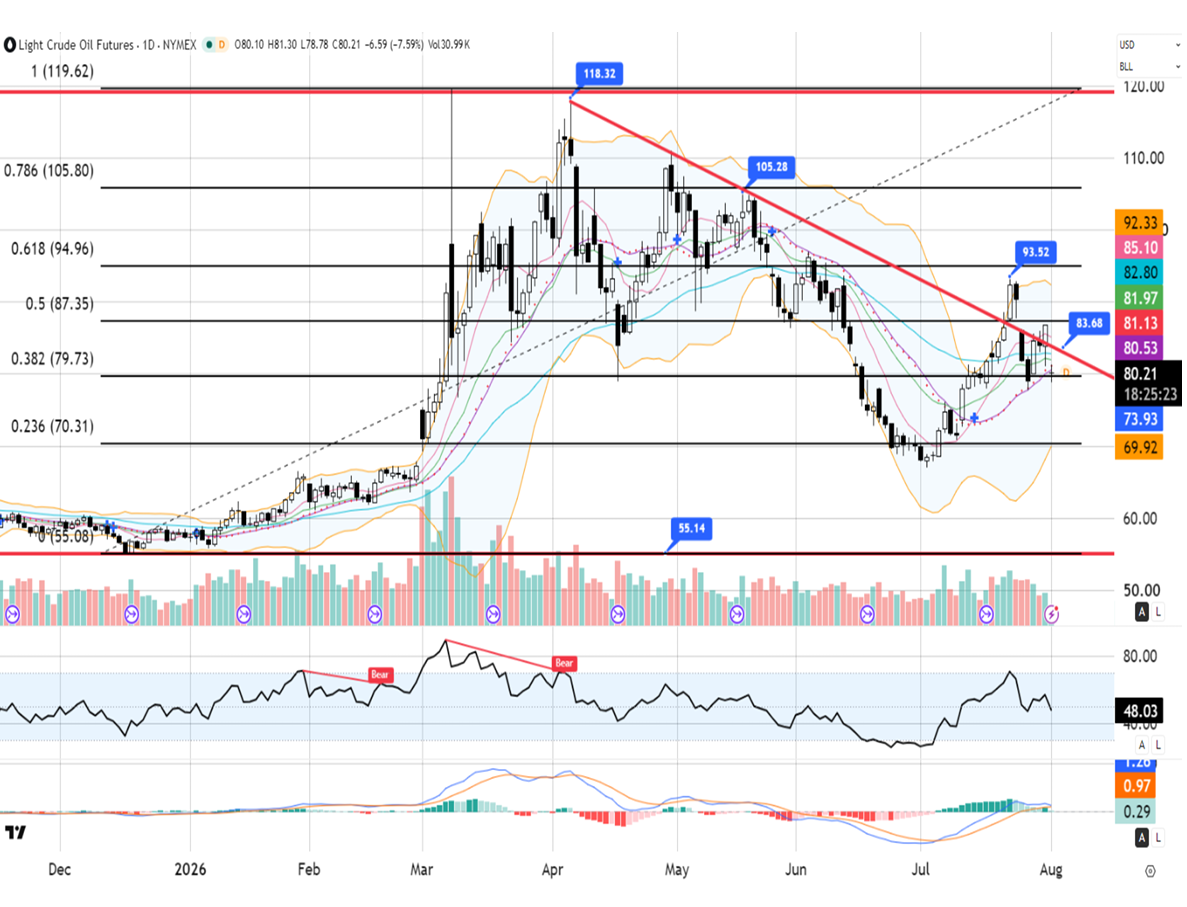
Technical View: $80.21. Price displays mildly bullish weekly signals in the
daily charts. This supports a breakout past the daily super-trend at 89.40
towards 92.60. Supports rest near 81.50 and 80.20, whilst an unexpected
dip below 77.75 risks renewed selling.
Copper
Copper futures climbed toward $6.5 per pound on Monday, reaching their highest
level in two weeks as ongoing supply constraints continued to tighten market
conditions. Analysts cited shortages of copper concentrate and scrap copper in top
consumer China, driving treatment charges and market spreads higher. Traders also
remained cautious over the prospect of new US tariffs on the metal, which has
encouraged the diversion of copper shipments into the US. In addition, copper
continued to draw support from its favourable long-term demand outlook, fuelled by
the global shift toward clean energy and the rapid expansion of artificial intelligence
data centres. Meanwhile, private data showed China's manufacturing activity slowed
to a four-month low in July as output and new orders expanded at a weaker pace,
dampening the demand outlook. The Politburo also indicated last week that it would
continue relying on existing policy measures instead of rolling out broad-based
stimulus.
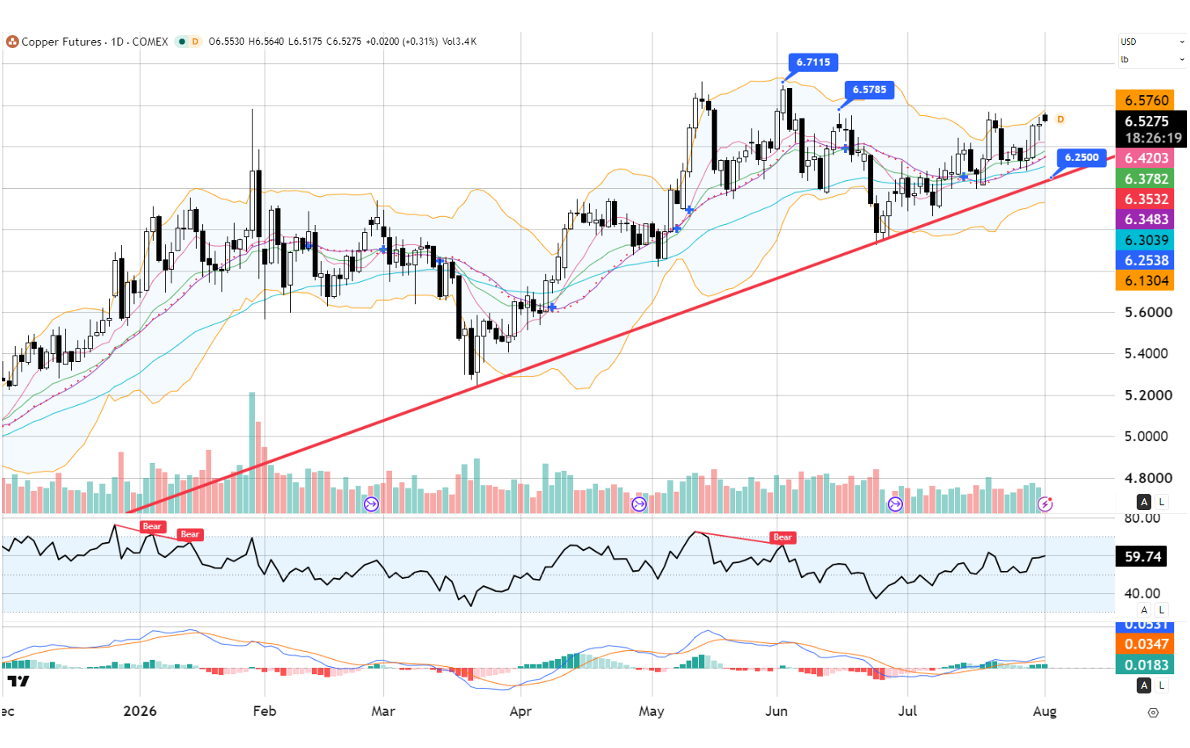
Technical View: $6.52. Charts indicate a minor dip to supports where price
could likely hold for a rise. Supports at $6.25/30. Resistance at $6.57/60.
Only a decisive cross above $6.60 could likely take prices higher to $6.70 or
even higher. Favored view is neutral to mildly bullish in the near term.