Teaser: Precious metals surged more than 1% on Friday following rumours that the United States and Iran may have agreed to extend their cease-fire, but they were still on track for a monthly fall as inflation concerns and forecasts of higher interest rates weighed on prices. President Donald Trump of the United States stated that he would make a decision regarding a possible agreement with Iran to prolong their ceasefire, which would require opening the Strait of Hormuz and destroying Tehran's ability to produce nuclear weapons. Higher energy prices related to the Iran war caused U.S. inflation to rise at its quickest rate in three years in April, according to data, supporting predictions that the Fed will hold interest rates constant well into next year. The opportunity cost of holding non yielding gold rises with higher interest rates. For the month, spot gold was down more than 1%.
Introduction:
Gold and silver extended their recovery this week as easing crude prices and growing optimism surrounding a potential US–Iran agreement improved sentiment across the precious metals complex. Markets increasingly focused on diplomatic efforts aimed at extending the ceasefire and gradually restoring shipping flows through the Strait of Hormuz, helping reduce inflation concerns that had weighed on bullion in previous weeks. Silver continued to outperform gold as improving risk appetite and easing macro stress supported both investment and industrial demand expectations. However, negotiations remain unresolved and geopolitical risks continue to linger in the background. Going into the week of June 1–5, precious metals are expected to remain sensitive to developments surrounding US–Iran talks, Fed rate expectations, and crude price direction, with easing energy markets supportive but volatility likely to persist.
WTI crude futures remained under pressure this week as hopes for a diplomatic breakthrough between the US and Iran continued to erode the geopolitical risk premium that had supported prices in recent months. Expectations that shipping access through the Strait of Hormuz could gradually normalize encouraged profit taking, while concerns over softer global demand added further pressure. Despite the correction, uncertainty remains elevated as negotiations have yet to deliver a definitive agreement and the risk of renewed disruptions to energy flows persists. The market also continues to monitor inventory trends and broader macroeconomic conditions for signs of demand strength. Going into next week, crude is expected to remain highly headline-driven, with prices likely to react sharply to any progress in
negotiations or renewed escalation in regional tensions.
Gold:
Gold steadied above $4,500 an ounce on Monday following a volatile week, as efforts to secure a longer-term ceasefire agreement between the US and Iran showed limited signs of progress. Over the weekend, Washington and Tehran exchanged proposals seeking amendments to a draft accord that would extend the ceasefire and reopen the Strait of Hormuz, though it remained uncertain whether the negotiations were moving closer to a resolution. President Donald Trump also reiterated his call for Iran to halt its nuclear program and fully restore the strait’s status as an open international waterway. Gold has faced headwinds since late February as the Middle East conflict drove energy prices sharply higher, fueling concerns about inflationary pressures and the prospect of interest rate hikes. Investors are now awaiting the latest US monthly jobs report later this week, which could offer fresh insight into labor market strength and the likely path of Federal Reserve policy.
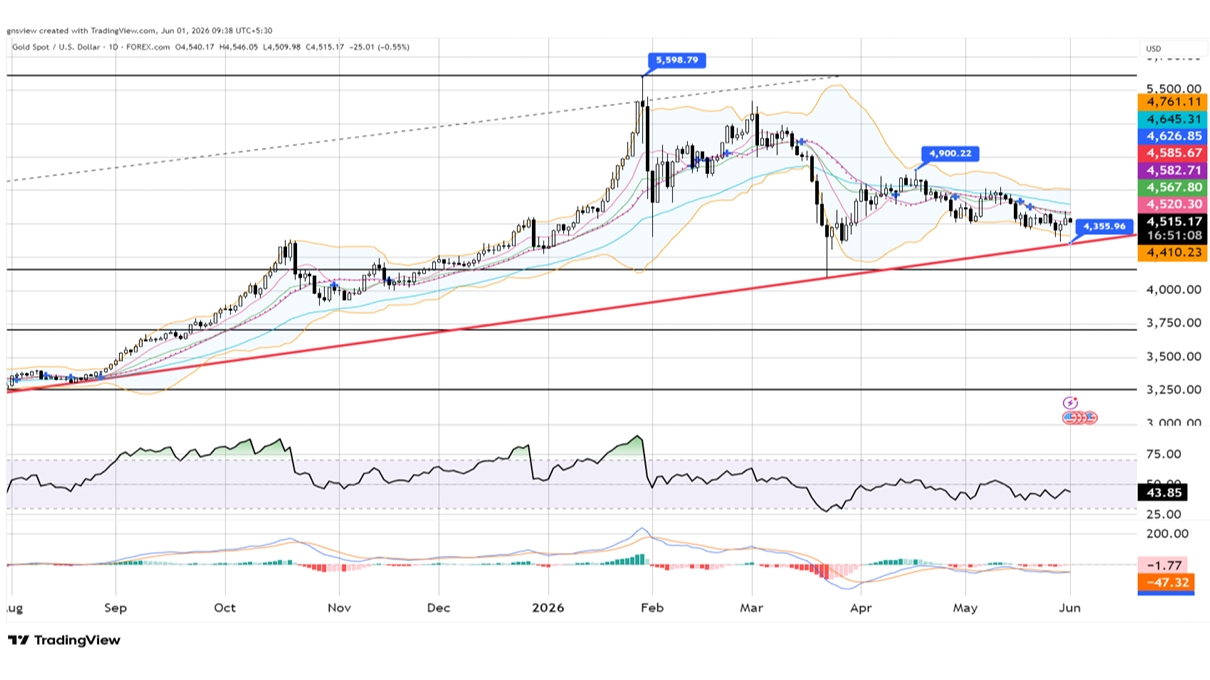
Technical View: $4515.17. The weekly chart suggests that the correction may be approaching its terminal phase, with cyclical indicators pointing to a potential bottom forming near 4315 or, at most, around the 50-week EMA at 4249. This raises the possibility of a recovery emerging from that zone. In the near term, chart indicates that buying interest is likely to strengthen only on a move above 4660, which could then open the way toward 4760–4780. Until such a breakout occurs, the structure favours a continuation of the corrective dip toward the 4315–4245 region before a meaningful recovery can unfold.
Silver
Silver steadied above $75 an ounce on Monday following a volatile week, as efforts to secure a longer-term ceasefire agreement between the US and Iran showed limited signs of progress. Over the weekend, Washington and Tehran exchanged proposals seeking amendments to a draft accord that would extend the ceasefire and reopen the Strait of Hormuz, though it remained uncertain whether the negotiations were moving closer to a resolution. President Donald Trump also reiterated his call for Iran to halt its nuclear program and fully restore the strait’s status as an open international waterway. Silver has faced headwinds since late February as the Middle East conflict drove energy prices sharply higher, fueling concerns about inflationary pressures and the prospect of interest rate hikes. Investors are now awaiting the latest US monthly jobs report later this week, which could offer fresh insight into labor market strength and the likely path of Federal Reserve policy.
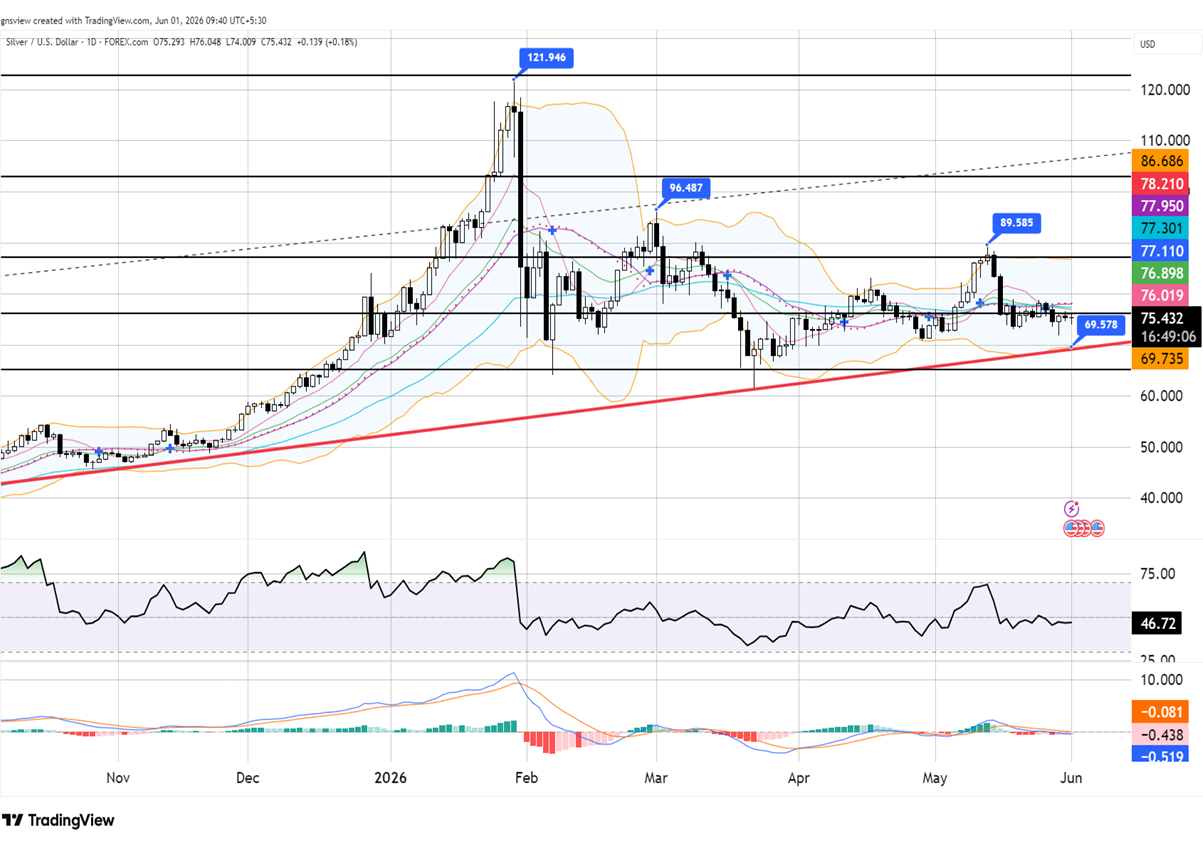
Technical View: $75.43. Supports at $69/67 could likely hold dips for a rise towards $87/89. Only an unexpected fall below $66 could dampen our bullish hopes.
Crude Oil
WTI crude futures rose above $89 per barrel on Monday, recovering part of last week’s losses as uncertainty continued to cloud prospects for a peace agreement between the US and Iran. Over the weekend, both sides exchanged proposals seeking revisions to a draft deal that would prolong the ceasefire and reopen the Strait of Hormuz, though it remained unclear whether meaningful progress had been achieved. President Donald Trump also reaffirmed his demand that Iran halt its nuclear program and fully restore the strait’s status as an open international shipping route. Although oil prices recently posted a monthly decline amid expectations that Washington and Tehran could eventually reach a more durable agreement, they remain elevated compared with pre-conflict levels as the near-shutdown of Hormuz triggered an unprecedented disruption to global energy supplies.
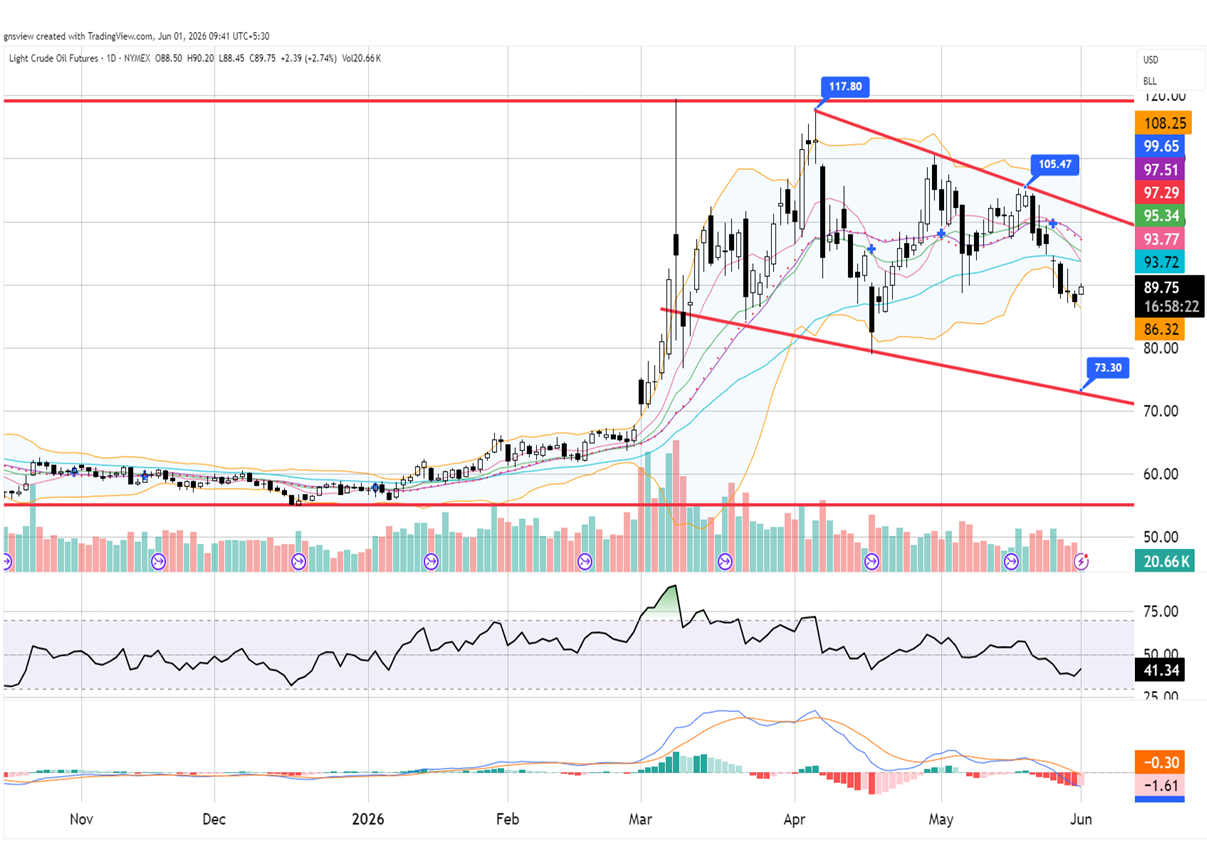
Technical View: $89.75. The immediate bias remains tilted to the downside, with $82.70 as the first objective and scope for an extension toward the key support at 78.25. On the upside, daily resistances at 90.60 and 92.50 are expected to cap and contain any short-term corrective rebounds. The structure turns vulnerable only on an unexpected move above 94.00, which would neutralize the bearish view, while a sustained break above 98.30 would negate the downside scenario altogether.
Copper
Copper futures held steady near $6.4 per pound on Friday and were on track to register a second straight monthly advance, underpinned by renewed optimism over demand linked to the global artificial intelligence expansion and the rapid build-out of data center infrastructure. Increasing copper consumption in global power networks amid the broader shift toward cleaner energy also continued to support the demand outlook. On the supply side, production constraints in top producer Chile prompted major refiners to scale back capacity and output. At the same time, rising copper imports into the United States ahead of potential tariff measures have added to concerns over tightening global availability. On the geopolitical front, reports that the United States and Iran reached a preliminary peace agreement helped ease concerns about supply disruptions, further shaping market sentiment.
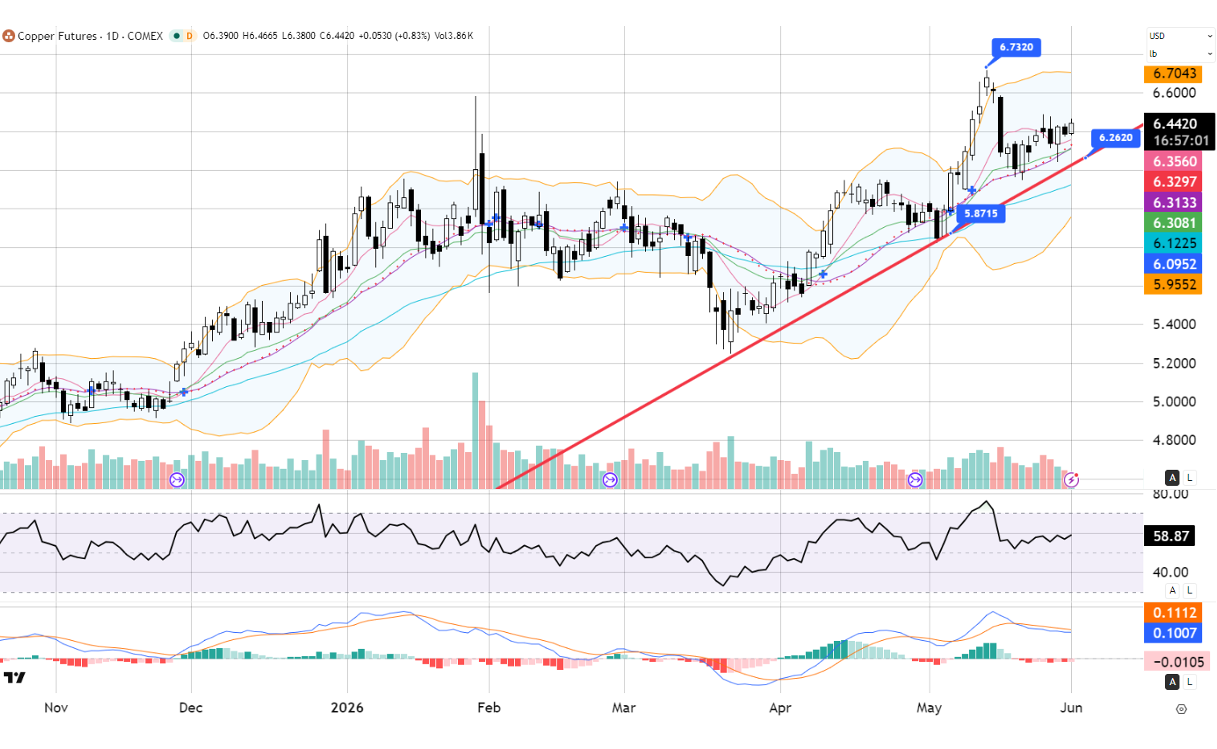
Technical View: $6.44. Supports to be observed at $6.25/6.20 where dips can hold for a rise to $6.65/6.70 near term. Only an unexpected breakdown below $6.10 could dampen our bullish expectations.