Teaser: Gold closed at $4,715 on Friday, while silver saw a surge to multi-week highs, supported by easing inflation concerns following a pullback in crude prices and a softer dollar. The late-week recovery reflects a temporary shift in sentiment as markets grew cautiously optimistic around diplomatic progress in the US – Iran war, reducing immediate pressure on interest rate expectations. The broader macro backdrop remains tight, with persistent energy risks keeping rates higher for longer. At the same time, continued central bank gold accumulation is providing an underlying layer of support, cushioning deeper downside risks. Silver’s quicker rebound also reflects rising market risk appetite and its response to both fiscal and industrial demand factors, causing some brief price swings.
Introduction:
Precious metals witnessed sharp two-way volatility, with gold stabilizing near the $4,600–4,700 range while silver outperformed, rallying toward $80 on easing inflation fears linked to a temporary easing in crude prices. The key driver remained the shifting narrative around the US–Iran conflict, where intermittent progress toward a potential agreement and reopening of the Strait of Hormuz helped reduce inflation expectations, supporting metals via softer rate outlooks. However, underlying pressure persists as elevated energy risks and resilient macro data continue to anchor expectations of a higher-for-longer rate environment, limiting sustained upside in bullion. Silver’s gains were further amplified by its dual industrial role, reacting more positively to easing macro stress. For the coming week, metals are likely to remain highly sensitive to crude price direction and geopolitical headlines, with a range-bound to mildly bullish bias, where dips may find support but rallies could face resistance unless there is clear confirmation of de-escalation and easing inflation risks.
Crude oil prices remained highly volatile, initially supported by escalating US–Iran tensions and continued disruption to flows through the Strait of Hormuz, before correcting sharply on renewed diplomatic efforts and expectations of a potential agreement. Prices slipped toward the low-$90s after reports of a US proposal to end the conflict and gradually reopen the strait, although uncertainty persists as negotiations remain fragile and subject to rapid reversal. The market continues to balance structural supply disruption against evolving diplomatic signals, making sentiment extremely headline-driven. For the upcoming week, crude is expected to trade with high volatility and a cautious downside bias, though any breakdown in negotiations or escalation in conflict could quickly reverse the trend and push prices higher again.
Gold:
Gold prices fell below $4,700 an ounce on Monday, giving back part of last week’s gains after President Donald Trump rejected Iran’s response to his peace proposal as “TOTALLY UNACCEPTABLE,” sustaining concerns over inflationary pressures. Reports indicated that Tehran had offered to move part of its highly enriched uranium stockpile to a third country, while refusing to dismantle its nuclear facilities. Meanwhile, renewed attacks across the Middle East over the weekend threatened to undermine a fragile ceasefire that took effect in early April. The Strait of Hormuz also remains effectively closed as Washington and Tehran continue to struggle toward a diplomatic resolution to the conflict, keeping energy prices elevated and intensifying inflation concerns. That strengthened expectations that central banks may raise interest rates further to contain price pressures, a development that tends to weigh on precious metals.
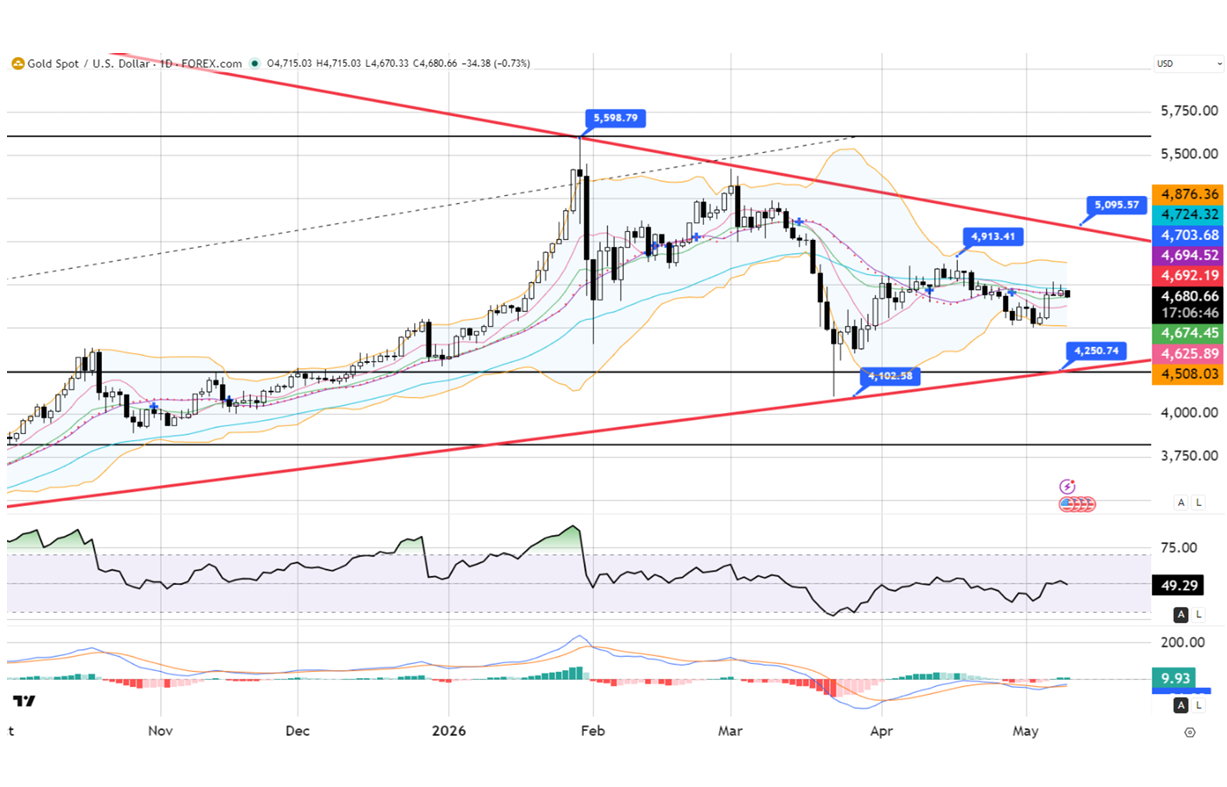
Technical View: $4680.66. The upside attempt appears to have stalled near the resistance at $4765. A sustained crossover above 4765 can expose the next major resistance near 4890. Weekly and daily charts retain mild bullishness, though not strong enough at this stage to confidently push the price beyond 4765. Supports are near 4595 and 4515. An unexpected fall below the weekly fractal low at 4500 can
encourage sellers, exposing the next support near 4385.
Silver
Silver prices fell below $80 an ounce on Monday, giving back part of last week’s gains after President Donald Trump rejected Iran’s response to his peace proposal, sustaining concerns over inflationary pressures. Reports indicated that Tehran had offered to move part of its highly enriched uranium stockpile to a third country, while refusing to dismantle its nuclear facilities. Meanwhile, renewed attacks across the Middle East over the weekend threatened to undermine a fragile ceasefire that took effect in early April. The Strait of Hormuz also remains effectively closed as Washington and Tehran continue to struggle toward a diplomatic resolution to the conflict, keeping energy prices elevated and intensifying inflation concerns. That strengthened expectations that central banks may raise interest rates further to contain price pressures, a development that tends to weigh on precious metals.
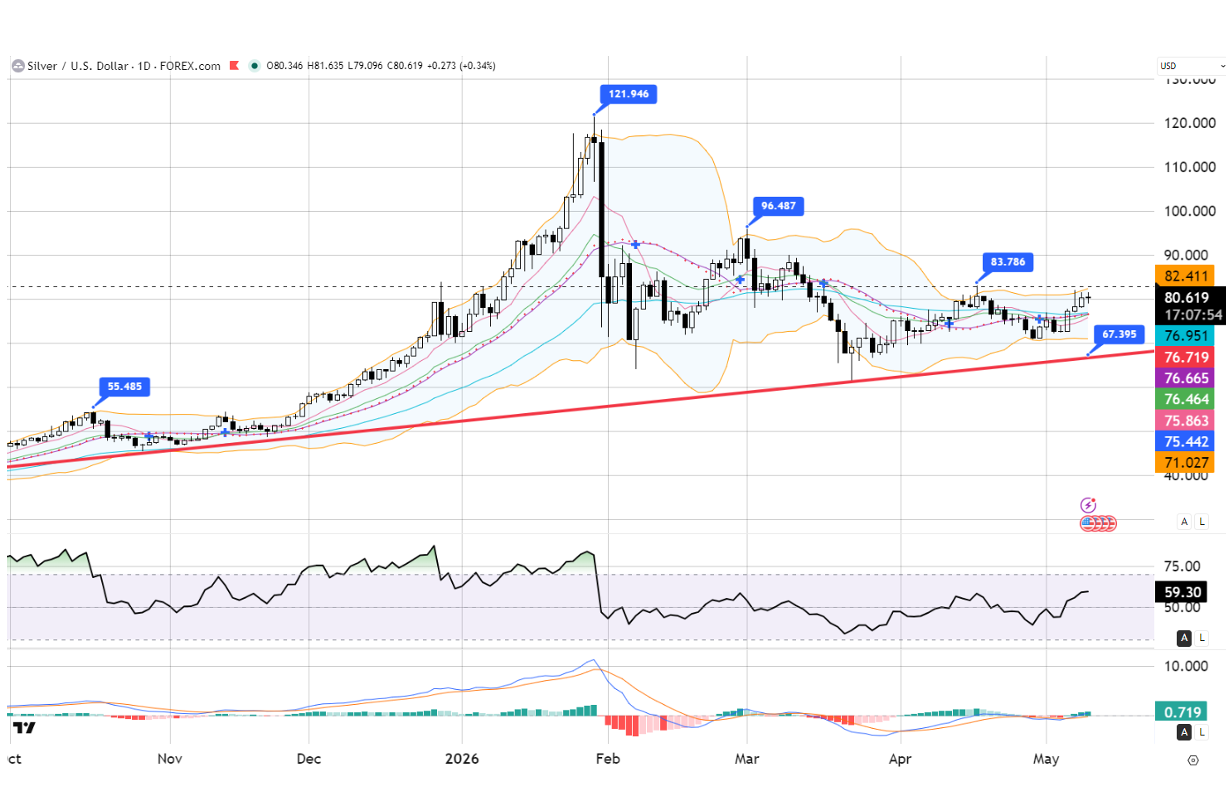
Technical View: $80.61. Resistance at $83/85 could likely cap any upticks for a decline to $70/69. Only an unexpected rise above $87 could turn the picture bullish again.
Crude Oil
WTI crude futures jumped 3% to above $98 per barrel on Monday, recouping losses from last week after President Donald Trump rejected Iran’s latest response to his proposal aimed at ending the 10-week conflict, leaving the Strait of Hormuz effectively closed. In a post on Truth Social, Trump called Tehran’s reply “TOTALLY UNACCEPTABLE,” amid reports that Iran had proposed transferring part of its highly enriched uranium stockpile to a third country while refusing to dismantle its nuclear infrastructure. At the same time, drone attacks struck a cargo vessel near Qatar in the Persian Gulf, while the UAE and Kuwait said they had intercepted hostile drones, raising fears that the fragile ceasefire reached in early April could collapse. The extended shutdown of the Strait of Hormuz has severely disrupted global flows of crude oil, natural gas, and refined fuels, triggering what the IEA described as the largest supply shock on record.
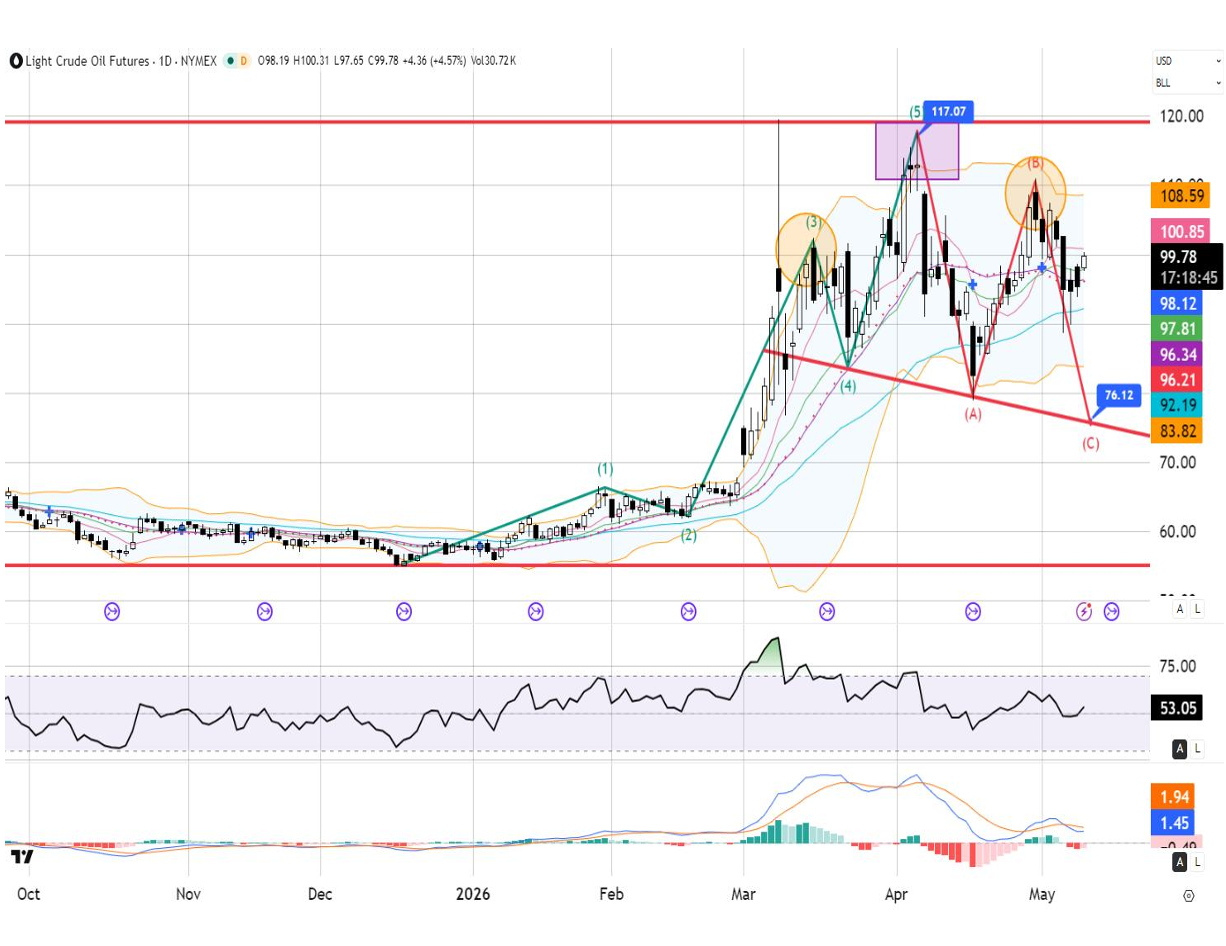
Technical View: $99.78. Weekly chart hints at the possibility of a corrective dip towards $89.00/88.75. Daily chart too shows a similar setup where the price can get attracted towards 89.50/89.00. Resistances are near 100.00/100.50. A push above 102.75 can trigger a trap-buy setup, increasing the chances of a rally towards or past earlier highs near 108.50/110.90.
Copper
Copper futures climbed above $6.2 per pound, approaching the record highs reached at the end of January, as investors increasingly expect that investments in AI infrastructure, power grid modernization, and clean energy will drive sustained long-term demand for the metal. Also, easing energy prices helped reduce concerns over global growth and industrial metals demand. At the same time, the ongoing Middle East conflict has disrupted shipments of sulphuric acid, a critical input in copper refining. China has banned sulphuric acid exports from May through at least December. The measure is expected to remove around 3M tonnes from the global seaborne market, significantly affecting major importers such as Chile, Indonesia, and India. Copper production in Chile had already declined by around 6% in the first three months of 2026 compared with the same period in 2025, even before accounting for the impact of sulphuric acid supply disruptions.
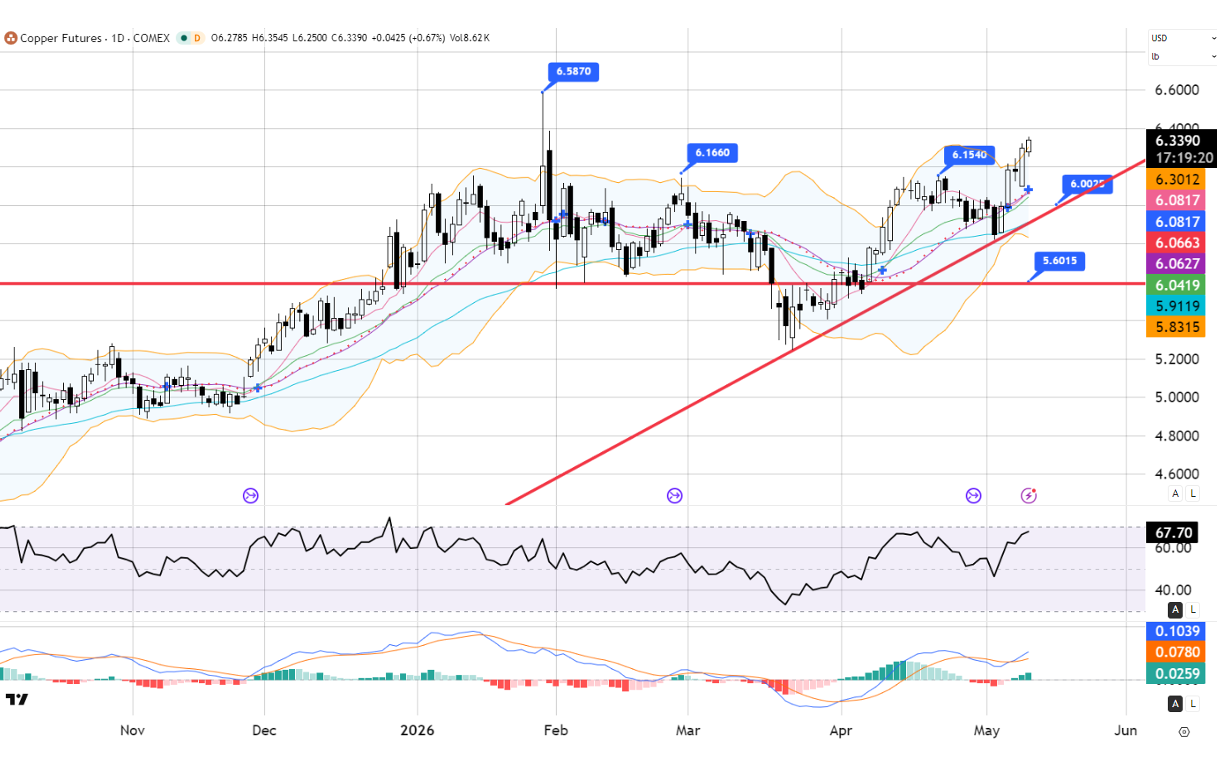
Technical View: $6.33. Supports to be observed at $6.11/6.13 where dips can hold for a rise to $6.45/6.55 near term. Only an unexpected fall below $6.10 could cloud our bullish hopes.